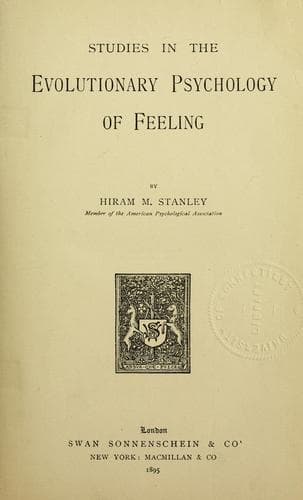
Studies in the Evolutionary Psychology of FeelingStanley, Hiram Miner
Philosophy
Studies in the Evolutionary Psychology of Feeling
Stanley, Hiram Miner
Emotions
power in a poem by Rossetti, or the simple human grandeur in a painting
by Millet. In some forms we know what it is to try to feel, to have dim
and vague stirring of æsthetic emotion, and to reach new levels in
emotion generally, and we know the stages of differentiation and the
severe _nisus_ of the earlier realizations. On the _nisus_ side of our
psychic life there is abundant opportunity for every one to observe the
process of mental differentiation, and how slowly evolving a new emotion
is, for instance, before it reaches a definite form, but there is the
great range of purely natural, spontaneous life, deriving its whole
_impetus_ from ancestral minds, where, as in hate and anger, it is
impossible to study the slowly modifying forms precursory to the
distinct mode. How can we find or produce in ourselves a state which is
not yet hate, but merely hate in becoming, a half-differentiated,
half-evolved hate? If we could put ourselves on the _nisus_ side, and
look up to hate as something to be reached, instead of something we may
fall into, we might attain some idea of its process of formation. But
since hate, anger, and so forth, invariably come upon us and overcome
us, how can we appreciate their evolutionary stages? If we could trace
these old intermediate disused forms which merely lead up to others, we
should find them very strange, and should need an entirely new
nomenclature for them. But to reach back and realize long outgrown and
fossil psychoses, will, if ever possible, require more exertion and
ability than even the intense struggle of the actual psychical advances
which adds, by the efforts of exceptional individuals—“geniuses”—new
modes of cognition and feeling to the mind of a race. To regress beyond
a certain point is harder than to progress.
How then hate developed from non-hate, from anger, or from any other
emotion, is obviously a very difficult problem. It would seem to us in
our present stage of mentality that the first hate phenomenon was
definitely and inexplicably such. We cannot perceive or conceive how the
origin of hate is other than a sudden apparition of a new and elementary
emotion in response to an extraordinary call upon some extraordinary
organism in its life career. Yet we may easily believe that the direct
occasion of its rise and progress was as complement to anger. Anger is
certainly in general a very advantageous self-conservative factor, but
by reason of its violence it requires a vast amount of vital energy to
accomplish its end, and it thus also tends to disturb the cognitive
power in its clear and cool actions. A burst of passion, though it may
succeed in destroying the injurious, is both uneconomical and
unintelligent. It is also a very transient phase. Anger will be defeated
and supplanted in the evolution of life by some factor which has not
these incidental disadvantages. Hate is such a superior psychosis, and
is surer, steadier, and more economical than anger, and defeats it in
the long run.
Public-domain text, read in full here on John Shaqi.
Reviews
Reviews
No reviews yet
Be the first to share your thoughts on this work.
Elsewhere in the archive
Join the Discussion
Join the discussion
Sign in to leave a comment or review.
Sign InorCreate an account