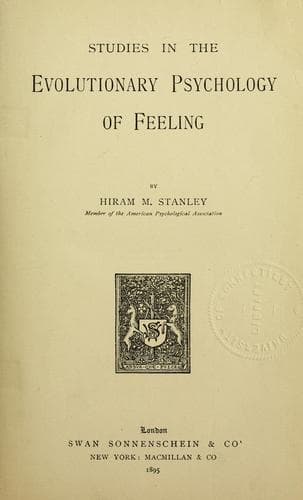
Studies in the Evolutionary Psychology of FeelingStanley, Hiram Miner
Philosophy
Studies in the Evolutionary Psychology of Feeling
Stanley, Hiram Miner
Emotions
But though on general scientific analogy we are led to believe in fossil
mental forms, in missing psychic links now extinct as regards our own
consciousness, but which were the germs of our present distinct
emotions, perceptions, etc., how are we to discover and investigate
them? Can we work our own consciousness back through the multitudinous
stages of its past evolution, through myriads of human and pre-human
forms to the confused, primal, undifferentiated psychoses?
Certainly the forms which lead up to such an emotion as hate and from
which it is gradually evolved must be realized, must be actually felt in
some measure before they can be understood and analyzed. Here then seems
a great barrier to introspective evolutionary psychology, perhaps
insuperable, for how can mind retrace itself, involute itself, in the
interests of science? Mind is fundamentally action, motive-feeling,
which, in connection with cognitive forms gradually achieved, becomes
from mere pure pleasure-pain a very complex manifold. We feel many of
these forms in our own experience, and we can say of some that they are
the higher, of others that they are the lower and more primitive. Thus
fear, anger, and hate are generally regarded as low action-motives as
compared with love of truth or justice. But while we distinguish in our
own consciousness and by analogy in the consciousness of others a
considerable variety of psychic forms, they are, so far as we are able
to see—and we have given some special attention to this in discussing
fear and other emotions—invariably distinct, and each has its own
peculiar quality, and we do not find, and we should not expect to find,
the intermediate forms any more than the anatomist would expect to find
in man a radial starfish structure. The hazy, indefinite phases which
mark evolving consciousness into new forms have been long done away with
for such emotions as hate, and it would seem an impossible task to ever
bring them back. When we let consciousness lapse of its own regressive
tendency—and undirected consciousness tends always to revert to _wild_
states—we fall down through a series, but it is by steps, and no gradual
descent, that is, defined mental forms succeed each other, with no
transitional phases which are both as differentiating into either. We
have mixed states, indeed, but these have no evolutionary value in this
line, being merely coincident distinct psychoses, and not an
intermediate differentiating mode. The psychoses which we call lower and
which we naturally _fall into_, were really a higher level once for some
remote ancestors, and it was only by occasional great efforts that fear,
anger, hate, etc., were reached, by just such efforts as now are
required by many a worldling who would be religious and would attain a
feeling for holiness, or that of a Philistine, ambitious of reaching
æsthetic feeling, who endeavours to appreciate the refined, elaborate
Public-domain text, read in full here on John Shaqi.
Reviews
Reviews
No reviews yet
Be the first to share your thoughts on this work.
Elsewhere in the archive
Join the Discussion
Join the discussion
Sign in to leave a comment or review.
Sign InorCreate an account