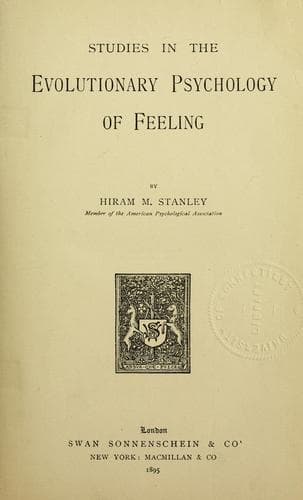
Studies in the Evolutionary Psychology of FeelingStanley, Hiram Miner
Philosophy
Studies in the Evolutionary Psychology of Feeling
Stanley, Hiram Miner
Emotions
The most notable revolution in human history against the general course
of evolution which we have been considering has come from Christianity.
The world says, “If any one smite you on the cheek, hit him between the
eyes”; the Nazarene says, “Offer him the other cheek also”; the world
says, “If any one takes away your cloak, fall upon him and despoil him
of his all”; the Nazarene says, “Give him your coat also”; the world
says, “Hate your enemies”; the Nazarene says, “Love your enemies, bless
them which curse you, and do good to them that despitefully use you.”
The law of natural evolution by fear, anger, hate, strife, is replaced
by a new law of a spiritual evolution through forbearance, humility,
love, loyalty to truth, to beauty, to goodness, and to holiness in a
kingdom not of this “world.” Life consists, not in making friends and
fighting enemies, but in a fight with one’s self to realize unselfish
ideals, to exemplify the highest principles and laws, and to achieve the
largest and best work, without regard to self-conservation or
self-aggrandizement. In this radically new evolution the mind is for
itself, and is not, as in the lower evolution, merely a utilitarian
factor, subservient to the general demands of life. Life, on the
contrary, here becomes subservient to the development of mentality
purely for its own sake. Thus pure science, art for art’s sake, an
independent morality and religion, become possible. The greatest minds
of the race are those who have lived most completely this highest life;
but this new form scarcely touches the great bulk of humanity, and is
very partially developed even in the so-called highest classes.
But it is not our present purpose to survey the higher evolution, or to
point out its _rationale_. For the lower evolution, however, it is
tolerably evident that fear, anger and hate, give the dominant tone to
psychic life. These strong, direct emotions act as fundamental life
factors; without them the individual would be quickly overwhelmed in the
struggle for existence. The conditions of early life absolutely require
these simple, naïve emotions to stimulate advantageous reactions.
Emotional indifferentism is possible only as an artificial and
by-product, a sort of disease or abnormal symptom even in the very
latest phases of human evolution. The comparative psychology of the
future will show more and more clearly and fully the nature and function
of both the fear and anger groups as factors in biologic evolution.
CHAPTER XI
_SURPRISE AND DISAPPOINTMENT, EMOTION OF_
_NOVELTY_
Public-domain text, read in full here on John Shaqi.
Reviews
Reviews
No reviews yet
Be the first to share your thoughts on this work.
Elsewhere in the archive
Join the Discussion
Join the discussion
Sign in to leave a comment or review.
Sign InorCreate an account