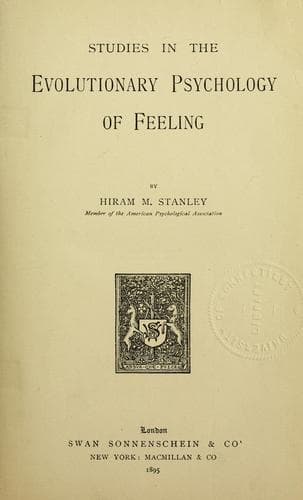
Studies in the Evolutionary Psychology of FeelingStanley, Hiram Miner
Philosophy
Studies in the Evolutionary Psychology of Feeling
Stanley, Hiram Miner
Emotions
To anticipate what is to occur is plainly one of the most useful
achievements of mind, for all providence implies apprehension and
emotion therewith. But to look before and after is certainly not the
prerogative of man alone, but anticipatory power is found throughout the
realm of mind, and constitutes the larger portion of all cognition. To
know a thing means, in general, to appreciate its potentiality; and all
science is really prescience. Knowledge is not the immediate sensation,
but the meaning of it for life; it is the ideal translation from one
sense to another in feeling tendency. Thus, to scent is by itself a
useless acquirement, but the connecting it with desired food is of the
utmost service. The psychism gradually attains the power to interpret by
various _media_ the nature, that is, the experienceability, of the
environment.
To foresee is then one of the commonest events in mind, and according to
the painfulness or pleasurability foreseen is felt anger or fear, hope
or desire, or allied emotions. But the foreseen does not always come to
pass, and hence there results a new order of intellectual and emotional
reaction. That what we had in mind would happen comes not, or is other
than foreseen; this has a disturbing effect on cognition and emotion.
Prescience defeated becomes not merely nescience, but there is the
positive definite shock of surprise, and the emotion of disappointment
or some correlated form. Surprise as the sense of contrast of real and
ideal, involving personal sense of limitation and error, is, as we have
noted (pp. 50 ff.), a painful experience. But where there is no
preconceived notion, no expectation, there is no surprise, as Lumholtz
remarks of the Australian savages, that they are not surprised at the
railway and other wonders of civilization; they do not know enough to be
surprised. The full apprehension and understanding of the gap between
ideal and real is but very slowly attained. At first the thwarting is
naturally and easily attributed to an enemy, and there is anger and
pertinacious violence, but ultimately, by sad and repeated experience,
mind is led to notice its own insufficiency, to feel that the conflict
between the actual and the expected is due to subjective error rather
than objective interference. Genuine surprise, as distinct from mere
nervous shock, is then, I think, a later phenomenon than is generally
supposed. What is often taken for surprise with animals and children is
really eager attention. Again, certain modes of fright are often taken
for surprise. But experience must have made a considerable advance in
apprehension of experienceability before a real surprise can be
manifested, which is always the correlative of a sudden contrariness of
experience to what was preconceived. Surprise involves a certain measure
of a theory of experience; in short, a more or less definite body of
knowledge. One who has framed no ideas of what experience should be can
Public-domain text, read in full here on John Shaqi.
Reviews
Reviews
No reviews yet
Be the first to share your thoughts on this work.
Elsewhere in the archive
Join the Discussion
Join the discussion
Sign in to leave a comment or review.
Sign InorCreate an account