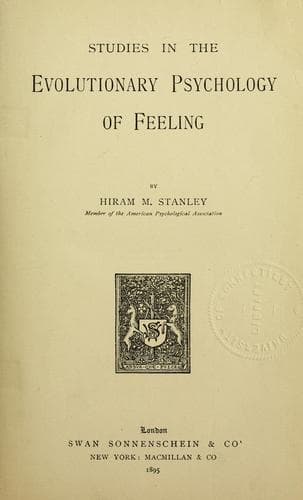
Studies in the Evolutionary Psychology of FeelingStanley, Hiram Miner
Philosophy
Studies in the Evolutionary Psychology of Feeling
Stanley, Hiram Miner
Emotions
With regard to the relation of novelty to pleasure and pain, the novel
and the sense of the novel is always in its inception under evolution by
natural selection unpleasant and painful. A novel experience is one
which can only originate in painful struggle, and the new is always _per
se_ distasteful to early mind, which is ever conservative in its
instincts and tendencies. A perfect life, biologically speaking, is one
which is perfectly adapted to its environment, and so goes through its
evolution with mechanically exact adjustment to circumstances; and the
novel would break in upon the unconscious rhythm which is here
perfected. Habituation becomes so iron fast that the novel, even when
distinctly pleasurable in itself, is resented, much less is the novel
sought for its own sake. However, so far as a novel experience may come
rather by way of regressiveness than progressiveness, it may delight us
by its novelty whenever the mind becomes capable of appreciating
novelty. Thus purely hereditary tendencies, which we do not accomplish
but which are accomplished in us during youth, as, for instance, the
sexual evolution, may charm, not only in themselves, but for their
novelty as well. But this experience which is not merely novel to the
individual as springing up spontaneously by _impetus_ from the past, but
which is novel for the race, and requires effort to assimilate, and so
is in the distinct line of higher evolution, as, the achieving a high
spiritual sentimentality in love; this, the real novel, is inevitably
and naturally painful. The first time the emotion of humility—a
comparatively recent evolution—was experienced by a human being was a
truly novel experience, though it is quite uncertain whether there was
with it either sense or sentiment of novelty.
If the novel and the novel experience—and these terms are practically
identical—are essentially painful, whence and how arises the peculiar
pleasure which we undeniably may experience in connection with the novel
appreciated as such? Must all such pleasure be placed to the account of
regressiveness? But pleasure of this kind is intrinsic in the act itself
and not for its novelty _per se_. There is a wide variety of experience
intrinsically either pleasurable or painful, which may be pleasurable to
us solely by reason of its novelty. I may enjoy the novel experience of
tasting a pomegranate, be the actual experience agreeable or
disagreeable, merely enjoying the novelty as such. What is this novelty,
why is it noticed, and why does it give occasion to pleasure or pain in
emotional form?
As we have already pointed out, the sense of the novel and emotion about
it cannot be said to arise with novel experiences in general. The novel
in the objective sense is the first occurrence of any given definite
kind of psychosis, as humility or pity, in the history of mind, and this
novelty is probably not at first appreciated.
Public-domain text, read in full here on John Shaqi.
Reviews
Reviews
No reviews yet
Be the first to share your thoughts on this work.
Elsewhere in the archive
Join the Discussion
Join the discussion
Sign in to leave a comment or review.
Sign InorCreate an account