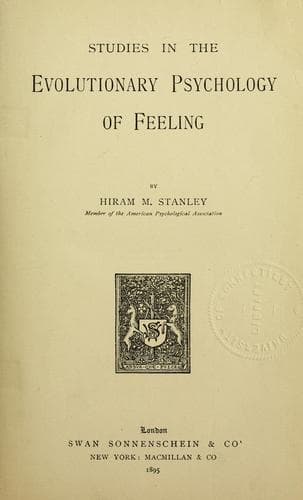
Studies in the Evolutionary Psychology of FeelingStanley, Hiram Miner
Philosophy
Studies in the Evolutionary Psychology of Feeling
Stanley, Hiram Miner
Emotions
Bain says that novelty is not an emotion, but “merely expresses the
superior force of all stimulants on being first applied.” But from the
point of view of psychic history the initial force of stimulants is
always very inferior and slight. For example, to taste and to
qualitatively distinguish tastes is an extremely slow growth in the
race, and by no means suddenly completed even in the offspring of the
most advanced individuals. Place a drop of wormwood extract on an
infant’s tongue and it may have a novel sensation and a disagreeable
one, as evidenced by the reaction, yet the real force of the sensation
is certainly quite inferior to that of a ten year old child in the given
case. The absolutely new impression is always slight, for mind is, in
the natural course of evolution, always slow at fully experiencing
things, it is by effort and by effort alone that it attains the several
orders of sensation and perception, and it is only by effort that they
are realized with greater and greater force and clearness. By the very
nature of psychic evolution as a progressive process toward helping
adjustability the novel exercises at the first but a slight reaction.
However, in the exigencies of existence the most wide awake, those most
susceptible to perceiving novelties and new circumstances and to being
suitably affected by them, have the advantage. Hence the apprehension,
interpretation, and application, of novelties is the path of progress
which finally culminates in the achievements of human invention. An
openness to the novel is thus of prime importance in a practical way,
though this is quite distinct from the pleasing sense of novelty.
However, the novel is not primarily attractive and interesting in and
for itself, but this must be accounted a late evolution in an artificial
period. The novel is at the first anything but charming. The absolutely
novel is never pleasant for its own sake.
It is only in a relative way that the objectively novel pleases, that
is, in the way of variety and change. Where overflowing mental energy by
reason of habituation finds no full and easy diverse activity the mind
is hampered and constrained. Thus youth in particular finds delight and
relief in new sights and sounds, in fresh experiences of all kinds.
Quickly wearied and exhausted in one channel and yet full of active
power, the mind springs rapidly from object to object along those lines
which ancestral experience has rendered the lines of least resistance,
thus especially in the plays and sports of childhood.
Public-domain text, read in full here on John Shaqi.
Reviews
Reviews
No reviews yet
Be the first to share your thoughts on this work.
Elsewhere in the archive
Join the Discussion
Join the discussion
Sign in to leave a comment or review.
Sign InorCreate an account