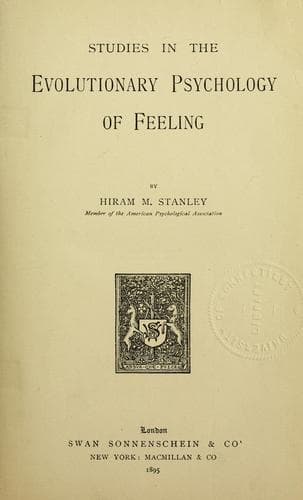
Studies in the Evolutionary Psychology of FeelingStanley, Hiram Miner
Philosophy
Studies in the Evolutionary Psychology of Feeling
Stanley, Hiram Miner
Emotions
It is always the conscious or unconscious significance for the
future that justifies revenge in the natural course of events; while it
is no remedy for my hurt, if some one has put out my eye, to put out his
in return, yet this revenge act, and so the feeling which prompts it, is
of highest prospective value with reference to future possible enemies.
Every one will know that I cannot be harmed with impunity. Despoil or
injure the revengeful in any way and you inevitably suffer for it sooner
or later, and so revenge acts as a protective psychical variation of
high value. On the whole the revengeful is less likely than others to be
molested and injured, and thus has a manifest advantage in the struggle
for existence. Revenge has, then, also rightfully its own subjective
sanction, a pleasure reaction, for revenge is, indeed, “sweet.”
Revenge is apparently found in a considerable range in the animal
kingdom, and seems universal in the _genus homo_. However, we cannot
infallibly conclude from certain actions that revengeful emotion is
present, and especially is this so in the case of animals. Thus, in the
well-known instance of the elephant, who, observing a man passing by who
had greatly annoyed him years before, suddenly drenched him with dirty
water, we are not necessarily to suppose that this elephant was prompted
by the emotion of revenge; although this may have been the case, we are
not perfectly sure how far the elephant did the act merely as recompense
for what the man had done, or how far the sight of the injurer, and so
one likely to injure, roused to simple anger and defence against the
threatening harmful. Many acts which seem like revenge are quite likely
to be common defence or offence, are done with reference to what the
object is and will be as injurious, based upon knowledge of the past,
and not as merely retrospective retributive acts. Memory for injuries
received is strong in many animals; that which has harmed is often
recognised after many years as the harmful, and appropriate simple
emotion, not revenge, is manifested. Rage, rather than revenge, is the
usual emotion among lower animals in special instances where revenge
might seem called for; and thus it is more likely that the elephant
should rage and hate rather than have pure revenge as in the case
considered.
Public-domain text, read in full here on John Shaqi.
Reviews
Reviews
No reviews yet
Be the first to share your thoughts on this work.
Elsewhere in the archive
Join the Discussion
Join the discussion
Sign in to leave a comment or review.
Sign InorCreate an account