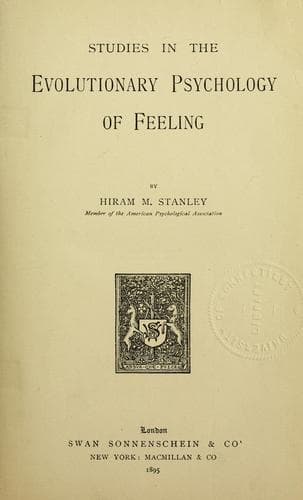
Studies in the Evolutionary Psychology of FeelingStanley, Hiram Miner
Philosophy
Studies in the Evolutionary Psychology of Feeling
Stanley, Hiram Miner
Emotions
One of the most important and interesting retrospective emotions is
revenge. The cardinal idea in revenge is returning evil for evil. Not
only must there be a paying back for past injury, but there must be an
equivalence, eye for an eye, and tooth for a tooth; and the revengeful
emotion is the meting out such purely retributive action. Exact return
becomes the basis of a general usage in animal and human societies.
Justice, law, and punishment rest upon the idea of inflicting duplicate
or equivalent injury for injury received. Administrative justice is the
specialization of revenge in the hands of a few members of a community,
a social differentiation by which individuals in general secure their
revenges at great economy by proxy. Further, the revengeful emotion is a
smouldering hate which vents itself only some time after the immediate
occasion. This is not the flush of anger which prompts to vigorous
offensive action upon the injurer at the very moment of harm perceived,
and it does not appear as stimulant to immediate self-conservative
activities, but is simply the spirit of getting even for relatively long
past injury.
What, now, is the function of revenge as a life factor? It surely does
not mend my injury that I do another harm solely because he has some
time harmed me, and the whole impulse might seem a pure waste of energy.
But under natural selection revenge must arise in serviceability of some
sort; and it is obvious that while revenge is of no use in mending the
past, it yet has a large value with reference to future possible injury.
Yet revenge is undeniably without conscious meaning for present or
future; it is merely the spirit and determination to get even, and so
its deterrent function is unconsciously attained. A dwelling in thought
on the past _per se_, a feeling about it and acting on it, while it
cannot help life directly, has a large value in its ultimate effect upon
enemies. He who never forgets injury, and for whom by-gones are never
by-gones, who never fails to return injury for injury, is feared and is
less likely to be injured. Junker, the African traveller, remarks of the
pygmies, “They are much feared for their revengeful spirit.” Thus, other
things being equal, the most revengeful are the most successful in the
struggle for self-conservation and self-furtherance. Though by itself
considered irrational and foolish to inflict return injuries upon an
injurer long after the immediate occasion, yet its deterrent effect is
very great with reference to other assailants. Thus, pure retrospection
may have unconsciously prospective value, or sometimes revenge may be
really retrospective-prospective, as when one says, “I will fix him so
he will not do that again.” Here function is consciously known, but in
instinctive revenge there is no such foresight, and, in general, utility
is no consideration with the revenger, whose mind is bent rather on
doing great harm for its own sake to his enemy rather than benefiting
himself.
Public-domain text, read in full here on John Shaqi.
Reviews
Reviews
No reviews yet
Be the first to share your thoughts on this work.
Elsewhere in the archive
Join the Discussion
Join the discussion
Sign in to leave a comment or review.
Sign InorCreate an account