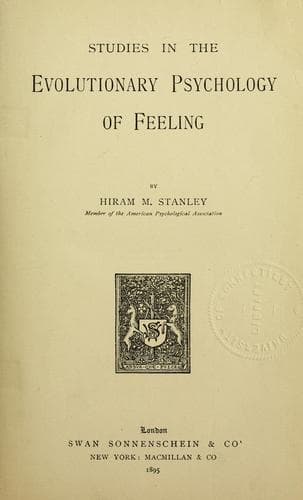
Studies in the Evolutionary Psychology of FeelingStanley, Hiram Miner
Philosophy
Studies in the Evolutionary Psychology of Feeling
Stanley, Hiram Miner
Emotions
We have to consider here only that simple primitive sorrow which is a
painful emotion at regarding personal loss or failure. Such simple
sorrow we see in the child who cries over spilled milk, in the man who
expresses deep regret at the careless misstep by which he broke his leg.
In this emotional reaction at the injurious the harmful is neither
escaped nor repelled, as through fear and anger; the feeling disturbance
is comparatively passive and purely reflective, and is not a spur to
some immediate advantageous defensive or offensive activity. In sorrow
we are pained emotionally at the trouble which has come upon us through
our own agency or otherwise, but we do not struggle from it or against
it, but there is purely helpless retrospection. Harm and loss which
might provoke in one nature to fear or anger, in another lead only to
inactive sorrow.
The cognition form in sorrow means always sense of _personal_ loss. I
may fear a thing, or I may be angry at a thing, but I can be sorry only
for a person. I do not feel sorry for a broken chair, though I may feel
sorry for having broken it. This view of one’s own personal agency in
causing harm to one’s self and harm to others is very prominent in a
large range of sorrow. In viewing any action which determined some evil,
I say, “I am sorry I did it.” This is, however, a later mode of the
emotion, which at the first cannot take account of any agency, but is
simply an acute feeling of distress at the injury received. Thus the one
who grieves over the spilled milk regards, not his own agency, but only
his loss; he is sorry, not that he spilled the milk, but that his milk
was spilled. Yet the sense of personal agency certainly forms a great
part in much sorrow, and tends to intensify it. I may grieve over any
harm that has come upon me, but my grief is intensified as I remember my
own agency in bringing it about. I may feel sorry over the loss of my
goods by fire, but if I lose them by my own careless act, my sorrow is
redoubled. Strictly speaking, perhaps, the sorrows are distinct, I feel
sorry for having done it and I am sorry at it done; yet they may be said
to constitute a single psychic state. Sense of our own agency, however,
in having produced harm to self is as likely to produce anger at self or
even fear of self. Hence our intensest and purest sorrows are apt to be
those occasioned by considering injuries occasioned by elemental forces.
That harm which we did not help because we could not, the inevitable
injury, this excites a keen regret and deep mourning.
The pain in sorrow is as peculiar, searching, unanalyzable and
undescribable as other simple emotion pains, and only conceivable
through realization. This sinking, helpless pain over what has happened
is clearly distinct from the sensation order of pains, and is in no wise
a reflection from them. The pain I have at remembrance of some great
loss which has befallen me is certainly very distinct from that which
came from the loss itself.
Public-domain text, read in full here on John Shaqi.
Reviews
Reviews
No reviews yet
Be the first to share your thoughts on this work.
Elsewhere in the archive
Join the Discussion
Join the discussion
Sign in to leave a comment or review.
Sign InorCreate an account