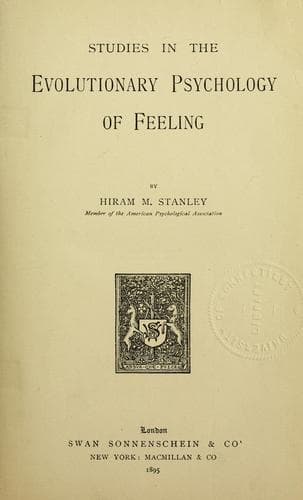
Studies in the Evolutionary Psychology of FeelingStanley, Hiram Miner
Philosophy
Studies in the Evolutionary Psychology of Feeling
Stanley, Hiram Miner
Emotions
What part now does sorrow play as a psychic life-function, and how
explain it on the general principle of natural selection? At first
sight, sorrow or grief over the past seems utterly valueless, seems to
be mental energy thrown away. The past is irretrievable, of what use
then is any grief? Is not all regret vain? To deplore its loss does not
tend to restore a lost arm, and it is of no use crying over spilled
milk. Indeed, he who bewails spilled milk has not only the actual loss
but the ideal pain about the loss. He who grieves suffers doubly. But
while it is true that sorrow for what has happened cannot alter the
occurrence, yet it has a permanent salutary effect on the one who
sorrows to give more caution for the future. The child will carry the
pitcher of milk the more carefully next time by the more he has grieved
over the past occurrence. By increasing sensitiveness and capacity for
sorrow experience is strengthened, deepened, and completely adjusted to
environment. Shallow and volatile natures, who take all loss and harm
easily, and even gaily, have little strength, and attain no great and
permanent growth. But with most, when the object of strong desire is
suddenly lost, not only will there be a disappearance of the positive
feeling about it, but an actual _minus_ or negative state will be
generated, a reaction mode we term grief. By this grief the chief
lessons of all higher experience are made possible. Grief is not a
pathological phenomenon in mind, but in its place thoroughly normal and
useful. Indeed, if under certain circumstances grief did not appear,
mind would be proved very crude, obtuse, or diseased. He who never feels
sad about what has happened, is not of a progressive or highly advanced
type. If one does not feel sorry for his past errors and hurtful
actions, he plainly has so much the less motive force to higher action
for the future. If sorrow had never entered the world of mind, if the
whole corrective for injurious actions or want of action lay wholly in
the immediate pain resulting or in the direct simple emotions like fear
and anger, a most potent factor in psychic progress would be lacking.
The possibility of going wrong, _i.e._, literally aside, and
contrariwise to one’s own interests, is implied in the struggle for
existence. The next best thing to the impossible _status_ of being
unable to do wrong, is to have the capacity of feeling for the wrong,
that is, of experiencing grief. Sorrow is thus a corrective of the
highest importance in the history of experience. The slips, willed and
unwilled, from the narrow path of upward evolution are of necessity
many; but a man is, on the whole, best doing the largest part in the
evolution scheme in which he finds himself, who both knows the wrong as
such, and is sorry for it, whether in the primitive selfish mode, or
better still, on the higher ethical and religious grounds. The greatest
and most efficient minds are those who have felt most keenly for their
Public-domain text, read in full here on John Shaqi.
Reviews
Reviews
No reviews yet
Be the first to share your thoughts on this work.
Elsewhere in the archive
Join the Discussion
Join the discussion
Sign in to leave a comment or review.
Sign InorCreate an account