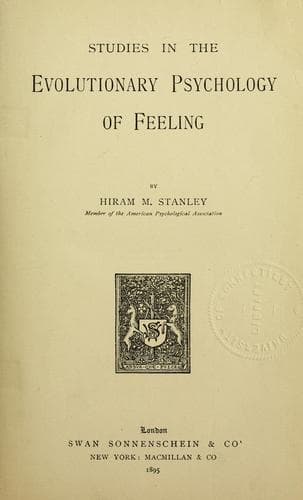
Studies in the Evolutionary Psychology of FeelingStanley, Hiram Miner
Philosophy
Studies in the Evolutionary Psychology of Feeling
Stanley, Hiram Miner
Emotions
Grief in its origin and its earlier occurrence is not the spontaneous
and almost irresistible impulse of our adult human experience, but, like
all emotion and all progressive psychism, is by effort of will. That is,
we must suppose that grief has its origin in some such _nisus_ as a
child exhibits when he is taught to be sorry for something he has done.
Hence it is only gradually and with the lapse of many generations after
its origin that sorrow becomes hereditary and spontaneous. At first
sorrow was a distinct attainment, rarely and but occasionally reached by
any individual, and it is comparatively late in psychic history that it
becomes a permanent and innate power. Sorrow also very gradually widens
its sphere. At first purely selfish, a retrospective reaction at one’s
own hurt, it becomes at length, through sociality and its concurrent
advantages, altruistic; sorrow is felt for others and the springs of
sympathy and pity are developed. That this altruism is very late
development is obvious, in that it has still to be taught even among the
most advanced of the human race to their children. The child is taught
to feel sorry for the cat he has hurt, for the blind man, for the
cripple. And we must conclude that at one time in psychic history
egoistic sorrow was likewise at the stage of development at which we now
see altruistic, and we may suppose that in the far future the altruistic
may come to the present _status_ of the egoistic sorrow. However, for
both there is an indefinite field for expansion, for refinement of
sensibility, and for readiness and appropriateness of manifestation.
Sorrow also will develop more and more on ethical and religious grounds.
Remorse arises and develops; and also the “godly sorrow for sin.” We
learn to feel, not merely sorry over the past as affecting our
disadvantage, but to feel sorry conscientiously as our deeds or those of
others conflict with the law of right or with the law of God. Those who
have no God-consciousness, and so no feeling about their action in the
sight of God, no sense of sinfulness, have yet often acute moral sense
and feelings. However, the origin and function of the moral and
religious sense in the light of natural selection is a wide subject
which can only be alluded to here; suffice it to say that sorrow is
thereby lifted to a peculiar and new plane of self-contained
spirituality. That is, the bearing of it is often without relation to
physical life-function, and even adverse thereto, and throughout has its
value and sanction in itself alone.
Public-domain text, read in full here on John Shaqi.
Reviews
Reviews
No reviews yet
Be the first to share your thoughts on this work.
Elsewhere in the archive
Join the Discussion
Join the discussion
Sign in to leave a comment or review.
Sign InorCreate an account