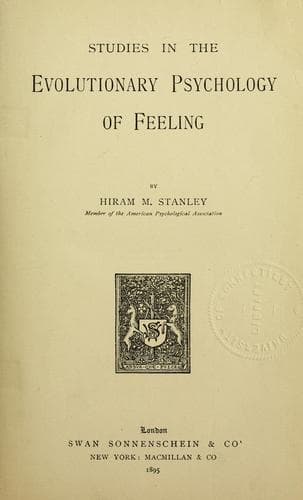
Studies in the Evolutionary Psychology of FeelingStanley, Hiram Miner
Philosophy
Studies in the Evolutionary Psychology of Feeling
Stanley, Hiram Miner
Emotions
This, it may be said, is all very true for a certain class of desires,
but the principle does not apply in the higher desires like the desire
for knowledge. But knowledge originates only as serviceable, and
primarily only serviceable knowledges are desired. We desire knowledge
only so far as it is worth having, and it may be that I esteem all
knowledge as worth something and so desirable. However, some knowledges
are worth nothing and are never desired. Who wants to know the exact
measurements of the pebbles on the road, or how many hairs are on the
mane of his neighbour’s pony, or the names of all the inhabitants of
Pekin? But if one thinks it would be any satisfaction to know such
facts, he may desire to know them. The insatiable curiosity of children
which seeks to know all such irrelevant facts hardly comes under the
category of desire, but is rather instinctive hereditary impulse. It has
no clear idea of a thing to be known and a desire to know it, but is
only a spontaneous outburst of knowing activity which is inbred and
comes from ancestral integration. There is a sensing and perceiving
activity which is very intense at the questioning age, but which hardly
implies the desire to know. The incessant “What’s this?” “What’s that?”
is merely outcome of an instinctive impulsion to interpret environment;
it is not significant of full-formed desire, there is no idea of thing
to be known, of an actualization to be accomplished.
If a man desires knowledge, not for his own sake, but for its own sake,
desire as such really ceases, it merges into love and devotion, which
are disinterested and clearly distinct as mental modes from desire.
Desire is not a sentiment; and it does not properly include all impulse
to actualization. For instance, the feeling for actualization merely as
such, for achievement of ideal _per se_, is beyond the biologic stage of
consciousness wherein desire has its chief function. The attainment of
end merely for the sake of the end must be distinguished from
actualizing an image for the pleasure of actualization, which thus has
desire element. We know that the image of realization may act as end by
compulsion, as in feeling of duty, which is thus marked off from desire
as impulsion. Thus desire is but one mode of teleological emotion. But
desire is emotion at unrealized good and not at unrealization in
general.
Public-domain text, read in full here on John Shaqi.
Reviews
Reviews
No reviews yet
Be the first to share your thoughts on this work.
Elsewhere in the archive
Join the Discussion
Join the discussion
Sign in to leave a comment or review.
Sign InorCreate an account