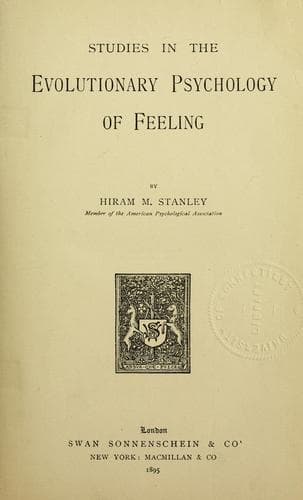
Studies in the Evolutionary Psychology of FeelingStanley, Hiram Miner
Philosophy
Studies in the Evolutionary Psychology of Feeling
Stanley, Hiram Miner
Emotions
We must also touch upon a certain class of experiences which have been
adduced as showing a desire not based upon the idea of the pleasure.
Take the example of a man in _ennui_ who takes to playing tennis as a
relief, but with no desire of being victorious. Engaging in the game he
finds that “this desire which does not exist at first is stimulated to
considerable intensity by the competition itself; and in proportion as
it is thus stimulated both the mere contest becomes more pleasurable,
and the victory, which was originally indifferent, comes to afford a
keen enjoyment.” (Sidgwick, _Methods of Ethics_, p. 46.) But does the
desire really come from some idea of pleasure? The player volleys a ball
successfully against his opponent, and thereby receiving a thrill of
pleasure desire awakes to beat. “Wouldn’t I like to beat him? I would
enjoy nothing better.” This desire foresees the pleasure of triumph. If
he gets no pleasure from returning the ball successfully he does not
desire success; but if unanticipated pleasure comes up in beating his
opponent, as soon as he recognises this pleasure he desires to continue
and complete it. This pleasure in succeeding in competitive activity,
extremely old and integrated from all the struggle of existence, springs
up spontaneously. There may also be added pleasure from activity and
pleasure from skill which will make the game very interesting, _i.e._,
full of desire and other emotions.
Professor Sidgwick allows that pleasure may be the cause of desire, but
not its object. But surely if I cognize pleasure coming from an act, I
attach this pleasure to it in representation; if I take pleasure from
returning a tennis ball and then represent a coming opportunity to
return the ball I also represent its pleasurability. Pleasure or pain
connected with acts is connected by association with representation of
the acts, the pleasure-pain tone penetrates the representation, and only
thus does actualization of an image become object of desire. If it is
possible to conceive an activity indifferent—which may be doubted—we
should have no emotion about it. But we have already sufficiently
emphasized how the perceived experience quality of things determines
desire and all emotion.
Professor Sidgwick’s remark that the pleasurableness of the contest is
“in proportion” (_Ibid_., p. 46) to the desire, _i.e._, that the
pleasure results from the desire rather than desire from the pleasure,
also shows defective analysis. If I desire intensely to beat, and am on
the losing side, I am greatly pained, for desire is always in itself
painful. In any case desire is pleasurable only so far as it is being
satisfied, which, of course, means only so far as desire is being
extinguished. It is not the increasing desire intensity, but the
decreasing, that gives pleasure, _i.e._, desire is negatively related to
pleasure. Intense desire may act as excitement-pleasure, but this does
not bear on the nature of desire.
Public-domain text, read in full here on John Shaqi.
Reviews
Reviews
No reviews yet
Be the first to share your thoughts on this work.
Elsewhere in the archive
Join the Discussion
Join the discussion
Sign in to leave a comment or review.
Sign InorCreate an account