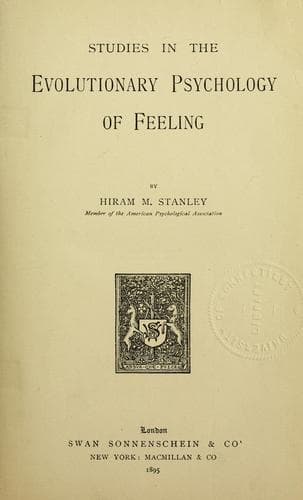
Studies in the Evolutionary Psychology of FeelingStanley, Hiram Miner
Philosophy
Studies in the Evolutionary Psychology of Feeling
Stanley, Hiram Miner
Emotions
Further, the relative presentations and feelings must be mentally
correlative, the connection must be more than phenomenal series of
several forms; there must be an active connecting psychic process as
basis. You are told to open your mouth and shut your eyes, and a bonbon
is dropped in; the taste will at once give rise to a revival visual
presentation, and if a person holds up before your eyes a fine bonbon,
saying, “look at this,” there may occur revival taste experiences. But
the immediate basis of desire is not here, for if psychic process
stopped here, there would be no higher elements; these can only be
accomplished by a definite bringing up and attribution of subjective
quality to the thing. You represent its possible pleasurableness on the
basis of past experience, by the action of the inductive instinct, a
complex process. Here revival is not an active correlating, but is
self-contained, lying isolated by itself, and unfruitful till its
revival character is recognised, and it is actively wrought into
experience. That is, integrating act is presupposed in all desire.
The way in which revival becomes the basis representation is hard to
trace, but in many cases it seems to be connected with certain
physiological activities. A revival form implies correlated physical
functions, as when the sight of a peach causes the taste pre-experienced
therewith to be revived, and the mouth waters, as if in actual
deglutition. As the reacting and assimilating process is carried on
without any real thing to be acted upon, there comes a physiological
reaction, which in turn gives rise to peculiar psychic affections, and
specially the uneasy feeling of lack. The unreality and mere revival
character of the revival experience is ultimately recognised, and
representation becomes possible, and idea of pleasure as both
experienced and experienceable is evolved. Thus an unsubstantial
revival, where the thing is sensed in one form only, but thereby
re-awakening other associated experiences, as in the case of merely
seeing a peach, leads finally to know the thing as a potency; I taste,
but after all I taste nothing; hence I am led to perceive the thing as a
sign, as unrealized in its pleasure significance, but realizable. How we
attain sense of reality and unreality we discuss in chapter on
Induction, but with special reference to desire we add here an
illustration. When engaged in reading on a hot day, I have feeling of
discomfort, and then spontaneously arises image of a wonted bathing
place, I have the image of moving in the clear, cool water, but at once
recognising the unreality of the image, I long for realization. I, when
heated, have so often seen the water, and plunged in it, that the
presentation of mode of relief has become firmly associated with the
discomfort, so when it organically returns, presentation revives, and
its unreality known, desire rises. One not accustomed to bathe, but to
Public-domain text, read in full here on John Shaqi.
Reviews
Reviews
No reviews yet
Be the first to share your thoughts on this work.
Elsewhere in the archive
Join the Discussion
Join the discussion
Sign in to leave a comment or review.
Sign InorCreate an account