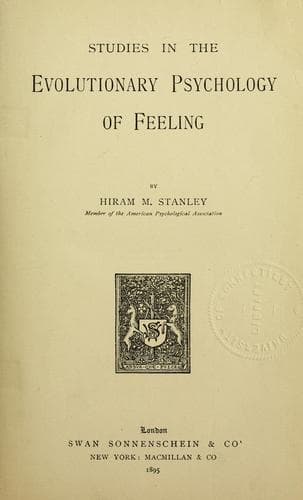
Studies in the Evolutionary Psychology of FeelingStanley, Hiram Miner
Philosophy
Studies in the Evolutionary Psychology of Feeling
Stanley, Hiram Miner
Emotions
7. The longing, yearning, peculiar desire quality as feeling mode.
8. Desire pain.
In the first place then, the object of desire, the _desideratum_, is not
the object as such. We do not desire things merely as such, but only as
far as they are significant of experience. Presentation does not, at
least normally and originally, ever end in itself, but it is always
connected, and connects with pleasure-pain experiences. Desire begins by
being vague as to its object; under slight pressures of pain we want
something, but we know not what; we have dim, undefined longing, but the
indefinite object is always a possibility of experience, a centre of
pleasure-pain potency. At the first stirring of hunger pains, we have a
vague uneasiness and sense of lack, with a most general idea of object
and longing toward it, and suffer the pain from hunger. We may be
physiologically hungry without feeling hungry, and so may have a desire
of thing in general to remove pain before the pain is felt and
recognised in its particularity as hunger pain. When hunger comes, or,
primitively, is achieved, then we want something to eat; and as this
feeling intensifies, the craving becomes more and more definite as to
object; bread, etc., is wanted, and in famine hunger there is the most
particular representation, as of certain dishes formerly eaten with
great relish. Lumholtz, wandering famished on a Christmas in the wilds
of Australia, thinks of the puddings in his native Norway. The
evolutionary significance of this increasing definition of object in
desire is obvious in that greater definiteness and accuracy of
self-preservative action is thereby assured.
As far as the nature of the emotion desire goes, it seems quite
indifferent whether there is presentation or representation of object. I
desire equally, whether I actually see the bonbon on the table or when I
merely represent it—see it in my mind’s eye.
Public-domain text, read in full here on John Shaqi.
Reviews
Reviews
No reviews yet
Be the first to share your thoughts on this work.
Elsewhere in the archive
Join the Discussion
Join the discussion
Sign in to leave a comment or review.
Sign InorCreate an account