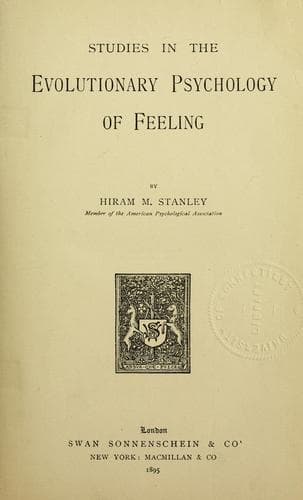
Studies in the Evolutionary Psychology of FeelingStanley, Hiram Miner
Philosophy
Studies in the Evolutionary Psychology of Feeling
Stanley, Hiram Miner
Emotions
Primarily then, and always, even in the latest evolution, as tendency at
least, the desire is for the pleasure in the object, and desire is
excited by every representation of the pleasurable. If one says, “I can
look upon pleasure without desire,” we may well question whether there
is really personal pleasure represented. Dancing, card-playing,
wine-drinking, may be pleasures which do not attract me because I do not
care for them; and by such a statement we indicate the practical
parallelism of pleasure and desire which is forced upon common
introspection. If you care for it, it is a pleasure to you; if you do
not care for it, it is not a pleasure to you; such is the result of
common observation, and a very just conclusion so far as I can see. To
excite desire, we naturally suggest the pleasurable. One person
persuading another to go to a party says: “I know you would have a good
time.” When one answers, “I know that I would have a good time, but I
dread the trouble of getting ready”; here is a conflict of desires in
which desire of present ease and comfort may overcome desire of future
pleasure. We may, indeed, assert that one cannot honestly say, “I know
it would be a great pleasure to me, but I have no desire for it.” When
such a phrase is used, it can only mean that the pleasure is interpreted
as belonging to the generic class of pleasures, yet not a pleasure to
the individual in his present conception, or else its contingency,
implied by “would,” is so great that desire is practically _nil_.
And if the pleasurable is always the desirable, the desirable also may
be said to be only the pleasurable. The martyr in his most eager desire
for a painful death, fixes his mind, not upon the pain as pain, but upon
the enduring it successfully, and the triumphant pleasure, also the
satisfaction of the reward of martyrdom, and the pleasure of suffering
for right and the approval of conscience; these and many other factors
influence him.
Public-domain text, read in full here on John Shaqi.
Reviews
Reviews
No reviews yet
Be the first to share your thoughts on this work.
Elsewhere in the archive
Join the Discussion
Join the discussion
Sign in to leave a comment or review.
Sign InorCreate an account