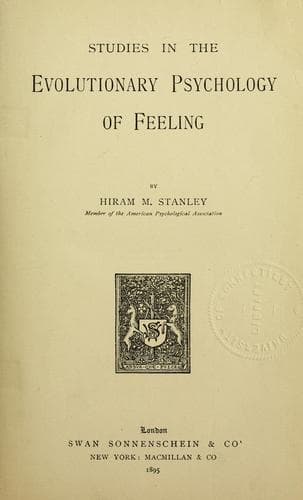
Studies in the Evolutionary Psychology of FeelingStanley, Hiram Miner
Philosophy
Studies in the Evolutionary Psychology of Feeling
Stanley, Hiram Miner
Emotions
If no pain was felt in the experience of unreality and lack, if there
was mere passivity, desire would not be generated. This pain of loss
spurs the mind to achieve desire, and desire enables the organism to
attain the advantageous. At length a conventionalized world of
desirables so formed, and certain significances, become so inground into
experience that they seem often to be instinctively and immediately
recognised by the individual, anterior to any personal learning by
experience, as in cases of instinctive fear of, and desire for, certain
objects.
While desire is attained at the incitement of pain, it is in itself a
painful mental act. The emotional going out toward the _desideratum_ is
in itself a painful mode of consciousness. The feeling I have for the
bonbon which I see and desire is, so far as desire, painful, yet
negatively and comparatively, it may be pleasurable in that this
psychosis may supplant one more painful still. It may be said that
desire is painful, and also lack of desire, or _ennui_. But mere
desirelessness is not _ennui_. _Ennui_ is a feeling of lack and loss,
and so a feeling of desire, but a peculiar kind of desire. It is desire
for activity, when by a morbid _status_ there is no desire moving to
activity. Lack of desire and interest in things may be painfully
revealed to some active natures, but to the great majority of psychisms
it is a pleasure state. As far as we can judge, the undesire of the cow
leisurely chewing her cud in a warm corner of the barn yard is supreme
felicity. A state of desirelessness, complete yet blissful, occasionally
visits even the consciousness of the nineteenth century busy-body. But
the normality of desire for human adult consciousness in general is
apparent to all. One who loses all interest or desire loses hold on
life. Thus desire is life, and even when it is sought to extinguish it
either as dictated by a philosophical maxim or by religious and moral
scruples, on account of the innate selfishness of desire—Madame Guyon,
for instance—yet desire is sure to intrude, and must as a desire to
destroy desire. So whether we _would_ fly, or _would_ reach desire, we
thereby desire. We may uproot or cultivate certain kinds of desire which
thereby become objects of aversion or desire, but the effort to
extinguish desire as general fact of psychic life involves either a
psychological indefinite _regressus_ which is never desireless, or else
it means the extinction of consciousness itself in any grade above the
lowest.
Public-domain text, read in full here on John Shaqi.
Reviews
Reviews
No reviews yet
Be the first to share your thoughts on this work.
Elsewhere in the archive
Join the Discussion
Join the discussion
Sign in to leave a comment or review.
Sign InorCreate an account