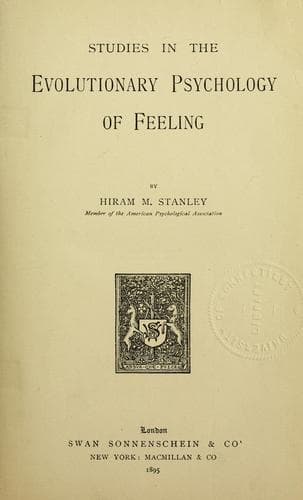
Studies in the Evolutionary Psychology of FeelingStanley, Hiram Miner
Philosophy
Studies in the Evolutionary Psychology of Feeling
Stanley, Hiram Miner
Emotions
Desire is _at_ pleasure, not _in_ pleasure, and thus contains pain,
especially as implied in the preparative factors, sense of unreality and
sense of lack. A bonbon may be so cunningly imitated, that placed in the
mouth it feels like a bonbon, yet not tasting so, the painful sense of
unreality and loss occurs. There is a painful waking up to the fact of
non-realization, much the same in quality as that which we suppose to
have happened in the original genesis of desire. The pleasant
hallucination is broken in upon by actuality not fulfilling the psychic
co-ordination pre-established under more favourable circumstances; and
this occurs in early psychisms on a wider variety of occasions than in
later development. That I am not tasting the bonbon I see on the table,
this fact _per se_ does not pain me. I take it as a matter of course in
an order of nature already well learned and completely acquiesced in.
But with infantile and lower stages of evolution generally, the lack of
immediate correlation seems highly painful. Seeing has directly
developed in immediate connection with a tasting, and the seeing without
tasting seems by its very nature as disquieting as the feeling in the
mouth the artificial bonbon without being able to taste is for later
experience. It is through the negations of customary coincident
impressions that anticipation and desire become forced by the exigencies
of life. The early psychism is limited in its adjustments to a very few
simple coincidences, but in the struggle of life in complex nature there
comes disruption of these primitive co-ordinations, and sequences become
apprehended, and meaning is discerned in things. This disruption
primitively occurred most easily when there was direct opposition to the
usual course of sensations. Just as when mouthing the imitation bonbon,
we apprehend most quickly and easily non-realization when it tastes sour
rather than sweet. By realities continually breaking in upon the common
course of psychic association, the significance of things is gradually
apprehended, and to see a thing is understood not merely as coincident
with other sensations and perceptions, touching, tasting, and
pleasure-feeling, but the thing is cognized as centre of pleasure
potency, and so can become object of desire. Experience loses its
self-contained simplicity, and is forced in the struggle of experience
in a complex environment into some definite understanding of things, and
into a feeling for them or at them, and not merely a feeling from them.
And so a world of desirables and aversibles is formed.
Public-domain text, read in full here on John Shaqi.
Reviews
Reviews
No reviews yet
Be the first to share your thoughts on this work.
Elsewhere in the archive
Join the Discussion
Join the discussion
Sign in to leave a comment or review.
Sign InorCreate an account