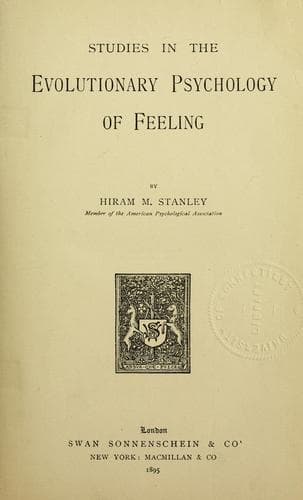
Studies in the Evolutionary Psychology of FeelingStanley, Hiram Miner
Philosophy
Studies in the Evolutionary Psychology of Feeling
Stanley, Hiram Miner
Emotions
determine its own experience, hope as passive seems a rather late
evolution, as having only an indirect and general value by maintaining
general pleasurable tone. The one who hopes it will be a good day
to-morrow is in a better and more advantageous frame of mind than he who
fears it will be a bad day, in so far as the events are equally beyond
self-determination, and it is of no direct use to either hope or fear.
As to the range of desire we must then disagree with Aristotle and later
psychologists, who suppose that desire is limited by the belief in the
possibility of realization. Desire existed before this belief was
generated; and while, after its generation, it may often affect desire,
yet often it does not. I may wish for the moon as readily as the child
to whom the notion of possibility or impossibility of realization is
beyond experience. The unrepresentable only cannot be wished, and desire
is bounded only by the power of conception and perception. Hope is a
species of desire which has to do with belief in the possibility of the
event or act: it is a joyful emotion connected with belief of
realization of the pleasurable. This distinction between hope and desire
in general is implied in the phrases, “I wish he _would_ do it,” and “I
hope he _will_.” The hope includes the desire, but the desire may exist
without the hope, as we say, “I wish he would, but know he won’t.”
Desire may be hopeless, but hope cannot be desireless.
Desire is vitally connected with ideation and volition, but properly it
is the intermediate emotional moment between these, and not idea of
pleasure—as James Mill—nor yet to be placed under will—Bain, James. It
is neither phase of ideation or volition. Desire is neither idea of, nor
striving after realization; it is not the idea of goal nor the effort to
reach goal. I may have idea of a goal without desire to reach it—at
least, analysis discriminates thus as separate mental stages—and I may
desire to reach it without trying to reach it,—impotent desire,
sometimes called wish. The striving is the consequent, and the idea the
antecedent of the desire which is the emotion wave we emphasize by the
word, longing. Desire is neither phase of volition nor ideation.
Volition is properly effort at realization, and is stimulated by the
emotion toward the realization ideally apprehended.
Public-domain text, read in full here on John Shaqi.
Reviews
Reviews
No reviews yet
Be the first to share your thoughts on this work.
Elsewhere in the archive
Join the Discussion
Join the discussion
Sign in to leave a comment or review.
Sign InorCreate an account