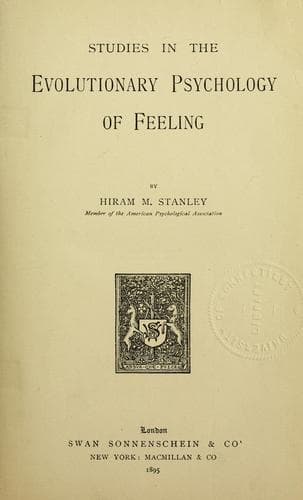
Studies in the Evolutionary Psychology of FeelingStanley, Hiram Miner
Philosophy
Studies in the Evolutionary Psychology of Feeling
Stanley, Hiram Miner
Emotions
The relation of desire to will has been a fertile subject of discussion
from Aristotle down, but we have to take up but a single aspect, namely,
whether will and desire may with reference to the same object be
contrary or distinct. Take the example of contrariety mentioned by
Stewart. I wish a certain man not to do a certain act, but yet I
persuade him to do it at the request of a friend. If I say I will
persuade him, though I wish him not to be persuaded, this merely implies
that the wish to oblige my friend overcomes the aversion to persuading
the man. And, in general, apparent cases of conflict of will and desire
may be resolved into conflict of desires. Hence the phrase, “I will do
it, though I do not want to do it,” is inaccurate or rather an
incomplete analysis. We should always add, “because I have some
extraneous and stronger desire.” A box of bonbons is hung in a room at a
height to be had by whomsoever will jump and reach it. In any party of
persons there may be some to whom the wish for ease, the disinclination
to jump, overcomes the inclination for the bonbons, so that this
volition does not occur, others who jump even against this
disinclination, the desire for the bonbons being the stronger desire,
and others, very active, who jump without feeling any disinclination to
the act. Conflict of desires is a common and almost constant state with
many minds, and the evolution of man has been mainly through conflict of
desire in sacrificing an immediate to a future good. In lower minds with
so little self-consciousness and consciousness of a consciousness that
they do not grasp conduct as a whole, there is a simple alternation of
volitions flowing from the desires of rival goods, till one by its
intrinsic force dominates with some permanence. These are the creatures
of impulse, unreflecting and unself-directing by principle and reason.
Higher minds realize _their_ situation and consciously bring in higher
desire or motive; they form rules and principles of conduct: they become
ethical beings, having self-control and self-direction.
Public-domain text, read in full here on John Shaqi.
Reviews
Reviews
No reviews yet
Be the first to share your thoughts on this work.
Elsewhere in the archive
Join the Discussion
Join the discussion
Sign in to leave a comment or review.
Sign InorCreate an account