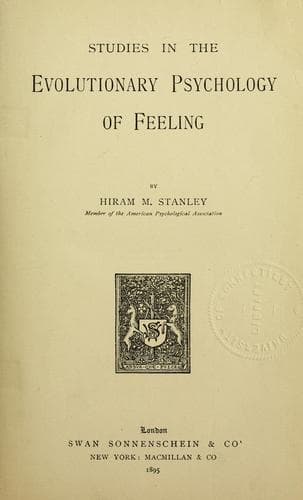
Studies in the Evolutionary Psychology of FeelingStanley, Hiram Miner
Philosophy
Studies in the Evolutionary Psychology of Feeling
Stanley, Hiram Miner
Emotions
Desire is based by Mr. Bain on hindrance and opposition to activity, on
“a bar in the way of activity.” This is true if we understand it to
refer to sense of unreality and of lack as connected with an
apprehension of thing where the thing is really absent from the usual
correlation, and hence physiological activities are checked. We have in
the previous pages discussed this, but this is not Mr. Bain’s point of
view. The three elements he emphasizes are: deficiency, idea of
pleasure, and the hindrance. Thus, he contrasts the prisoner who looks
out on a bright day and longs to take a walk, with a perfectly free man
who looks out on a fine day and freely follows his inclination to walk.
However, it appears to me that both have desire, and that in the same
sense both are moved by the motive, though only one is free to attain
the action. So if I get thirsty in a waterless desert or in my room with
a jug of water on the table, the bodily sensations will equally lead to
desire. The conflict in desire is between state actual and state
conceived, and not between will and restraint. Mr. Bain remarks, “If all
motive impulses could be at once followed up, desire would have no
place.” (_Emotions and Will_, p. 423.) But desire is itself an original
impulse, and is more or less an ingredient in all emotion impulse; and
it is plain that emotion impulses as implying representation are the
only ones which can be “followed up.” Where every wish is gratified as
soon as formed, as with a petted child of rich parents, desire still
remains in all its characteristic quality. Such an one, however, by
having only the momentary pleasure of completed realization, misses the
joys of realizing, and loses all that happiness which has been defined
as sense of progress. If every wish were gratified as soon as formed, if
every representation of pleasure was immediately followed by
realization, desire would still exist in all its peculiar force. The
moment of gratification is always second to the moment of desire, and a
Fortunatus with his wishing-cap cannot possess in absolute coincidence
with the wish.
It may be objected that Tantalus’ desire is certainly a form where
hindrance is the main stimulant. When one is continually hindered just
on the point of realization, desire is intensified, but this
intensifying is very largely due to the increased definiteness of
presentation or representation, and to the increase of confidence in the
event. To tantalize is to bring before one an object of strong desire
into the clearest prominence and seemingly certain attainment, yet to
constantly withhold it.
Public-domain text, read in full here on John Shaqi.
Reviews
Reviews
No reviews yet
Be the first to share your thoughts on this work.
Elsewhere in the archive
Join the Discussion
Join the discussion
Sign in to leave a comment or review.
Sign InorCreate an account