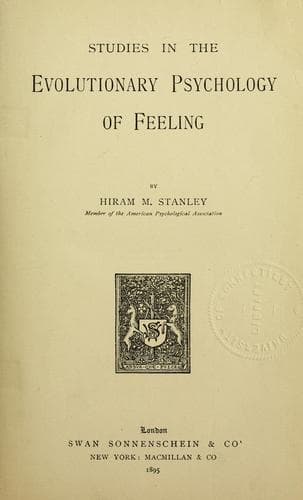
Studies in the Evolutionary Psychology of FeelingStanley, Hiram Miner
Philosophy
Studies in the Evolutionary Psychology of Feeling
Stanley, Hiram Miner
Emotions
The general function of desire in life is obvious; it is the most potent
factor in conserving and extending life. Far back in a paleozoic psychic
period life was below desire; but once originating under the pressure of
the struggle for existence it has since developed into the most manifold
and complex forms. Human life is the outcome of desire, and the human
being is _par excellence_ the desiring psychism. As the moving factor of
humanity history is its record, and present human organization, faculty,
and achievement is its product. Desire, as the force to realize, to
convert seen potency into actuality, the idea into reality, is now in
the very highest examples of psychic development an ever increasing
power, and no prospect of a psychic stage to be reached beyond desire is
intimated in the present course of normal development. The tendency
toward extinction of desire, when it does occur, appears always as
pathologic or retrogressive symptom. It may be the dream of a
philosopher or of a cult, but with Schopenhauer himself desire was a
most forceful factor, and the devotee of desirelessness by very reason
of being a _devotee_ to an object, desires it, namely, the state of
desirelessness. We may desire to extinguish certain desires, and succeed
in accomplishing this, but to desire not to desire, as general act, is a
psychological contradiction in terms. A very low vegetative psychic
status without any desire is possible, but all teleologic activity
implies desire, hence extinction of desire can never be attained as an
end.
Desire moves the world and is the core of psychic being. Deprived of
definite desire, we long for it, and if every wish were immediately
realized, we should desire delay in gratification. The amount and value
of life is measured by the quantity, quality, and effectiveness of
desire. Orton characterizes the Indians of the Amazon as “without
curiosity or emotion,” which must, however, be taken only as relatively
true, but yet marking them as extremely low in the psychic scale.
Education then, is a process of stimulating desire, of leading to
ambitions and aspirations. As what is imposed on consciousness without
desire is a hurtful burden, the true pedagogic method is always to
awaken the wish for knowledge and power before it is granted. Desire as
interest is assimilating power, and without it there is no mental
growth. The art of education is the art of stimulating intellectual,
æsthetic, moral and religious desires, and of providing for their
progressive gratification with the best arranged and most suggestive
material.
CHAPTER XIV
_SOME REMARKS ON ATTENTION_
Public-domain text, read in full here on John Shaqi.
Reviews
Reviews
No reviews yet
Be the first to share your thoughts on this work.
Elsewhere in the archive
Join the Discussion
Join the discussion
Sign in to leave a comment or review.
Sign InorCreate an account