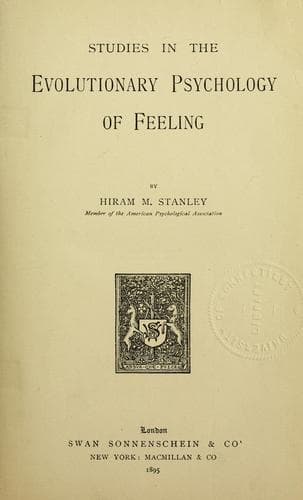
Studies in the Evolutionary Psychology of FeelingStanley, Hiram Miner
Philosophy
Studies in the Evolutionary Psychology of Feeling
Stanley, Hiram Miner
Emotions
The term attention is, like feeling, a word of extremely doubtful and
variable import. Like feeling, attention may be used as denominating any
stage of consciousness, or it may be restricted to some more or less
specific form. As affections of the organism all psychoses are termed
feelings; viewed as subjective-objective acts, a content being attained,
consciousness as such is termed attention. We are said to be attending
when we have any activity of mind, when we have anything in the mind or
before the mind. When consciousness has something in it, consciousness
is attending, whence attention means consciousness acting. But what is
consciousness inactive? Nothing. Hence consciousness attending, used for
consciousness acting, is a pleonasm. Consciousness, by virtue of always
being conscious of something, does not need the word attention to
qualify it.
The attention of consciousness is called, attracted, or engaged, when
any mental act occurs, whether a pain, pleasure, perception, or whatever
form it may be. When the mind is occupied with anything, _i.e._, is
active, it is thereby attending to the thing. If I am conscious, I am,
of course, conscious of something, hence attending to that something.
But all these expressions are incompatible with a purely psychological
point of view. In psychics, as opposed to physics, the thing exists only
as perceived and in perceiving, _esse_ is _percipi_; the object or
content of consciousness exists neither beyond consciousness nor in it;
it is consciousness and consciousness is it, it is nothing more than
objectifying fact. Consciousness does not, like a pail, have contents,
but it is merely a name for the sum of activities we term conscious.
Such a phrase, then, as, attending to something, may be radically
misleading. We do not have both consciousness and a field of
consciousness, a presentation field. A tolerably constant part of human
consciousness is an activity which is a constituting a world of external
and internal objects. This objectifying activity, which may or may not
be object for higher activity—apperception or attention in one
sense—does not, however, persist and subsist as a more or less
mechanical _continuum_, as Mr. James Ward and that school maintain.
Still the word attention may in a vague and general way denote both the
realizing force and will effort therein of every act of consciousness.
But yet as thus a general term for certain aspects or general qualities,
it is liable to misconstruction, and we do not propose to employ it
either as denoting any act of consciousness as such, or any aspect
thereof.
Public-domain text, read in full here on John Shaqi.
Reviews
Reviews
No reviews yet
Be the first to share your thoughts on this work.
Elsewhere in the archive
Join the Discussion
Join the discussion
Sign in to leave a comment or review.
Sign InorCreate an account