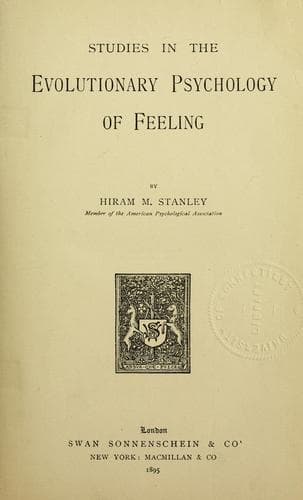
Studies in the Evolutionary Psychology of FeelingStanley, Hiram Miner
Philosophy
Studies in the Evolutionary Psychology of Feeling
Stanley, Hiram Miner
Emotions
In a more restricted sense, attention is not merely any will tension in
cognition, but only so far as self-consciousness is involved in all the
exertion. We must sharply distinguish between this attention as willed
activity and as simple act of will. Willed cognitive activity denotes
cognition determined upon and consciously accomplished. The willing in
the knowing act may not be will to know. Willed cognitive activity, when
not against the will, when including choice and acquiescence, is in the
true sense voluntary attention—attention voluntarily, freely, willingly
performed. The term voluntary is not the proper correlative of
spontaneous, but rather volitional, while non-voluntary must be set over
against voluntary. In self-conscious attention of any kind there must be
consciousness of the tension, and consciously exercised effort in
delineating and maintaining cognition. In this narrow sense attention is
conscious furtherance or hindrance of cognition. Effort is consciously
put forth in some particular cognitive form; there is a self-limitation
by the mind in cognitive process. In short, attention here equals
cognition consciously constrained.
As to the relation of attention to subject, we remark that psychology as
the science of mental phenomena, rather than science of the soul, is not
called upon to imply a subject as in any wise attending. Yet we use, and
use inevitably, substantive forms and personal pronouns, but while it is
impossible for science to desubstantialize language, yet it must be ever
on its guard against the delusions of language. It is a common impulse
to explain activities by referring them to agents, to describe attention
and all mental acts as being what they are by reason of the actor, the
self, or _ego_; but science in this, as in so many things, inverts the
common order; the agent is made by and of activities, and not the
reverse. Agent or subject is no more than a congeries of manifold
interdependent activities. There is, and can be, no fixing of the mind
by the mind: the word, mind, being used in the same sense in both cases.
When I say, “I fix the mind upon something,” this means for analytical
psychology, that in the complex of consciousnesses which are unified by
an _ego_-sense, there occurs a will effort accomplishing a perception.
This purely dynamic interpretation is the method of all science which
cannot accept inexplicable essences and agents as explaining anything.
Attention is not to be explained by an attender, but it is a mode of
activity in that collection of activities which we term organic life
with conscious process. So even attention, as self-conscious exertion,
is not to be interpreted as an agent which is conscious of itself in
exerting; but we consider it as volitional activity with consciousness
of self as manifold complex of objects vitally connected with will
effort. Self-consciousness does not necessarily mean a self conscious of
itself.
Public-domain text, read in full here on John Shaqi.
Reviews
Reviews
No reviews yet
Be the first to share your thoughts on this work.
Elsewhere in the archive
Join the Discussion
Join the discussion
Sign in to leave a comment or review.
Sign InorCreate an account