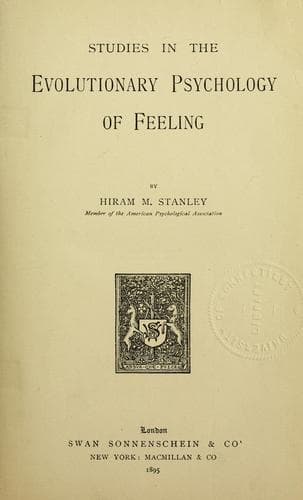
Studies in the Evolutionary Psychology of FeelingStanley, Hiram Miner
Philosophy
Studies in the Evolutionary Psychology of Feeling
Stanley, Hiram Miner
Emotions
It is obvious from our discussion thus far that we do not accept the
common division of attention into spontaneous and voluntary, which means
for us no more than spontaneous and voluntary—more properly
volitional—cognition. So-called spontaneous attention is the displacing
of one consciousness element by another without any will effort; there
is no displacing or placing as will activity, but cognitions appear,
persist and disappear by an inherent force. When in deep study the noise
of a whistle may spontaneously “attract my attention,” as the phrase is,
but this denotes no more than forcible change of state. There is nought
in the new act but the sensing the noise of whistle; there is no real
attending activity, no will effort at either promotion or inhibition.
However, we must grant that most cognition contains a volition element.
Absolute zero or negative value as to volition is but a momentary and
comparatively rare phenomenon in normal consciousness, where
self-possession and self-direction in some measure is almost constant.
In the case of noise of steam-whistle suddenly breaking in upon a
student, there is quickly attention—either positively, as listening to
quality, or to detect direction of sound; or negatively—true
_in_attention—as inhibiting and disturbing element. When one is made
“wild,” or distracted, by noise, then his mind is occupied unwillingly,
indeed, yet there being no real promotion or inhibition, we must term
the state _unattention_. Another form is where we give up in despair,
and passively suffer the annoying noise. In both cases we neither
stimulate nor repress, and so both are emotional unattentions. On
account of the pain-pleasure nature of all experience, there is even
here, however, some will attitude and tendency, some favouring or
retarding act, though it be wholly impotent in effect.
Public-domain text, read in full here on John Shaqi.
Reviews
Reviews
No reviews yet
Be the first to share your thoughts on this work.
Elsewhere in the archive
Join the Discussion
Join the discussion
Sign in to leave a comment or review.
Sign InorCreate an account