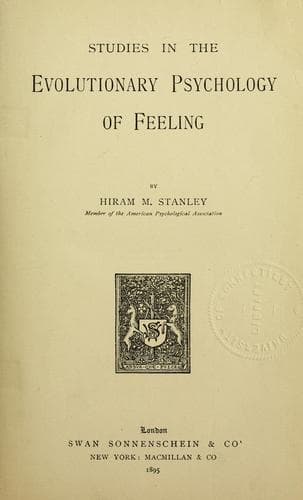
Studies in the Evolutionary Psychology of FeelingStanley, Hiram Miner
Philosophy
Studies in the Evolutionary Psychology of Feeling
Stanley, Hiram Miner
Emotions
If attention consists in cognitive effort, whether successful or not,
what is the nature of the effort to attend? A student says, I try to
attend, but I cannot; I cannot hold my mind down to anything. Professor
James remarks, “In fact, it is only to the _effort to attend_, not to
the mere _attending_, that we are seriously tempted to ascribe
spontaneous power” (_Psychology_, p. 451). But it is obvious in such
phrases attention means simply cognition, and may be substituted for it,
whereas we have just pointed out that attention is both the effort
toward and in cognizing act. Literally interpreted, then, the problem is
whether we can make an effort to make an effort at cognizing. In great
lassitude or exhaustion we lose control of ourselves, we are unable to
exercise volition either as attention or otherwise. We recognise and
lament the fact to ourselves, we feel our powerlessness, but I hardly
think we do ever really make an effort at effort. At the very first
stage of recovery from such state of utter non-volition, the will act is
always toward definite sense adjustments, or in holding to and promoting
certain thoughts and representations, and we thus have real attention.
The utter rout of psychoses, which once possessed us, we now conquer and
control for our ends and interests.
Attention to attention is obviously distinctively different from this
phase. We can and do attend to attention as psychic fact. An act of
attention cannot, indeed, attend to itself, but the volition act in
consciousness of consciousness, as consciousness of some attention act,
is very properly an attention to attention. If I am looking attentively
at a man, I cannot, by the very nature of attention, be simultaneously
volitionally introspective of, _i.e._, attentive to the looking
attentively. When actively sensing light, I cannot at the same moment
attend to this attention, because attention is always concentrative of
will. To be volitionally conscious of light is one moment, and to be
volitionally conscious of this light consciousness is another moment.
The attention attended to is not in process at the same moment as the
attention. This does not deny that we have simultaneous spontaneous
introspection of attentions. Introspection, like sensation, perception,
ideation, is attention only so far as it is effortful.
In his recent treatise on psychology Professor James discusses in an
interesting and suggestive way the relation of ideation to attention,
maintaining that “ideational preparation ... is concerned in all
attentive acts.” Attention is “anticipatory imagination” or
“preperception” which prepares the mind for what it is to experience.
Thus the schoolboy, listening for the clock to strike twelve,
anticipates in imagination and is prepared to hear perfectly the very
first sound of the striking.
Public-domain text, read in full here on John Shaqi.
Reviews
Reviews
No reviews yet
Be the first to share your thoughts on this work.
Elsewhere in the archive
Join the Discussion
Join the discussion
Sign in to leave a comment or review.
Sign InorCreate an account