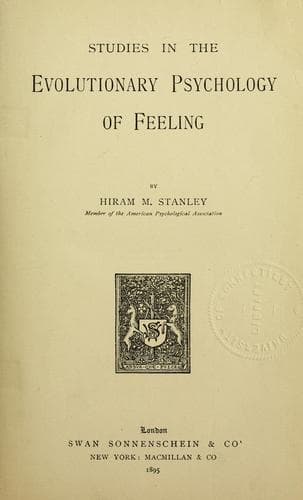
Studies in the Evolutionary Psychology of FeelingStanley, Hiram Miner
Philosophy
Studies in the Evolutionary Psychology of Feeling
Stanley, Hiram Miner
Emotions
Just when a cognition rises to attention point, just when volition with
effort becomes prominent factor, this is a difficult and delicate
problem. However, according to the relative prominence or obscurity of
volition element, we must divide cognitions into attentions and
impressions. In the variety of human cognitive activity there is a
constant flow of cognitions which are one moment being strengthened to
attentions, and another, weakened to impressions. With volatile persons
cognitive life is a kaleidoscopic congeries of rapidly experienced
impressions and attentions. Will darts in and out with marvellous
velocity, now vivifying some, now others, in the stream of cognitive
activities determined by pleasure and pain interest. With all of us
there is a manifold complex _continuum_ of cognition, a general
non-attention knowing of external world and _ego_, which we continually
carry with us. Into this field of exertionless cognitive life
will-effort penetrates now to one point, now to another, seizing upon
and enlarging the most interesting and significant facts. As I am
sitting in my chair, I am dimly aware, without will tension, of a large
field of varied objects, any one of which I may emphasize, attend to,
when incited by sufficient interest. Practically exertionless awareness
is a constant _substratum_ for developed consciousness; here, in the
world of habit, it is always at home, and moves with great ease and
smallest friction; but the process of learning, the work of adding to
mental possessions and enlarging the _totum objectivum_ and _totum
subjectivum_, this is attention for complex consciousness.
We must note this, that attention is any general alertness toward
cognizing, though no actual cognition be attained. Cognitive straining
without result is truly a form of attention. A man listening for a sound
is equally attentive with a man listening to a sound. It is not
necessary for an attention to have something to attend to. Attention is
effort at cognizing as well as in cognizing. The stupid boy is often the
most attentive, the most strenuous in cognitive effort, yet there may be
little apprehension. In fact, we must recognise that in cognitive, as in
muscular activity, effort may be excessive, and defeat its own end. When
suddenly awaking in the night we often strain sense to the utmost, but
with no result; nothing is heard or seen. In this, as in some other
cases, we must notice that attention is not necessarily delineation.
While generally a particularizing effort of cognition, attention may
sometimes occur as mere general cognition stress.
Public-domain text, read in full here on John Shaqi.
Reviews
Reviews
No reviews yet
Be the first to share your thoughts on this work.
Elsewhere in the archive
Join the Discussion
Join the discussion
Sign in to leave a comment or review.
Sign InorCreate an account