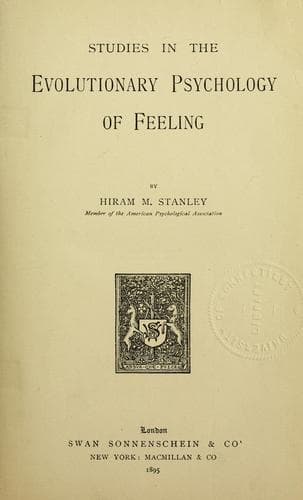
Studies in the Evolutionary Psychology of FeelingStanley, Hiram Miner
Philosophy
Studies in the Evolutionary Psychology of Feeling
Stanley, Hiram Miner
Emotions
When we have, then, a case of expectant attention, we must distinguish
the attention in the imaging from the attention in the actual cognizing.
It is, indeed, true for us almost invariably that cognitive strain
without immediate realization is incentive to ideating. In listening in
the night in vain for a sound we hear in imagination many sounds, and we
form preparatory ideas of what we are to hear. Sense-adjustments call up
a train of sensations in ideal form. But it is obvious that low
intelligences which have no power of expectancy or ideation do yet
really attend. The very first cognitions and all early cognitions by
their very newness and difficulty were attentions long before ideation
was evolved. With low organisms, as cognitive power extends only to the
present in time and space, immediacy of reaction is imperatively
demanded, and every tension of cognitive apparatus is immediately
directive of motor apparatus, so that suitable motion is at once
accomplished. The cognition, though dim and evanescent factor, is yet
powerfully energized, and so a true attention. Always with lowest
sentiencies, and often with higher, pain is suddenly realized without
anticipation, followed quickly by attention as strong effort to cognize
the nature and quality of the pain-giver and so to effectually get rid
of pain-giver and pain.
Preliminary idea, then, cannot occur in early attentions and in late
attentions, it is by no means necessary. It is said that we see only
what we look for, but it must be answered that seeing commonly happens
without any looking for. The kindergarten child, Professor James to the
contrary notwithstanding, is not confined in his seeing to merely those
things which he has been told to see and whose names have been given
him. A child continually asks, What is that? and is quick to discern the
new and strange. He accomplishes a wide variety of attentions without
ideas and gives himself almost entirely to immediate presentations.
To be sure, every one sees only what he is prepared to see, only what is
made possible for him by his mental constitution as determined by his
own pre-experience and the experience of his ancestors, but this does
not signify ideation. Every cognizing is conditioned by the past, but
this does not call for a reawakening and projecting in ideal form at
every instance of cognitive effort before any real cognition is reached.
Public-domain text, read in full here on John Shaqi.
Reviews
Reviews
No reviews yet
Be the first to share your thoughts on this work.
Elsewhere in the archive
Join the Discussion
Join the discussion
Sign in to leave a comment or review.
Sign InorCreate an account