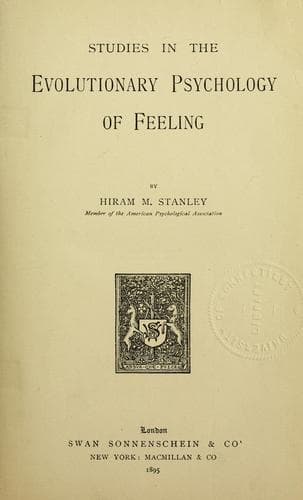
Studies in the Evolutionary Psychology of FeelingStanley, Hiram Miner
Philosophy
Studies in the Evolutionary Psychology of Feeling
Stanley, Hiram Miner
Emotions
In fact many, if not the most of our attentions, are merely
intensifyings of some present cognition, of some cognitive psychosis
which has simply come or happened. Take the instance of attention to
marginal and retinal images; this certainly does not always imply
pre-perception, the forming of an idea of what we are to see, though in
the cases mentioned by Professor James it may. For example, I was
writing the above seated with my profile to the window when I became
suddenly aware, through the physiological agency of a marginal image, of
a moving object to my right. This perception of bare, undefined object
was spontaneous, a pure given; I exercised no will in attaining it, and
so the state of cognition was not an attention. However, by attending,
by intensifying the cognition by will effort, I perceive that the
indefinite object is a man walking on the sidewalk, who is of a certain
height, clothed in a certain way, etc. I do not trace the least ideation
in the whole process; the slight attending as act of will did not imply
any anterior or posterior idea or representation. The reason for the
will act was the intrinsic interest of movement, and this intrinsic
interest arises in the fact that moving objects have had for all life a
special pleasure-pain significance; the moving object is the most
dangerous, and so motion perceived has become ingrained in mind as a
special stimulant of attention. This habit of attentiveness to things in
motion survives and continues for cases where it is of no use and even
of harm; thus, in the present instance, it diverts me from my work. It
is obvious that attention often occurs in the same way for other senses
without preliminary idea.
Is there such a state as negative attention or active inattention? Is
will activity in cognition always positive merely, and never existing as
direct repression or weakening of acts? To some psychologists negative
attention means only that certain elements in a consciousness are
overshadowed by the dominancy of some single factor; that, owing to the
limited capacity of mind, many elements can exist only in enfeebled form
beside their stronger neighbours. If the life blood of mind, will, is
largely absorbed by some particular form or mode, all other forms must
suffer in consequence.
Public-domain text, read in full here on John Shaqi.
Reviews
Reviews
No reviews yet
Be the first to share your thoughts on this work.
Elsewhere in the archive
Join the Discussion
Join the discussion
Sign in to leave a comment or review.
Sign InorCreate an account