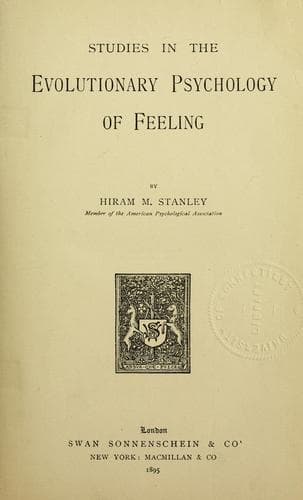
Studies in the Evolutionary Psychology of FeelingStanley, Hiram Miner
Philosophy
Studies in the Evolutionary Psychology of Feeling
Stanley, Hiram Miner
Emotions
It is, of course, obvious that the amount of will force which is put
into some given cognition is potentially or actually withdrawn from
other factors which then, however, are more justly termed unattentions
than inattentions. But is the withdrawal of energy attained only by
transference? May it not be attained by direct repression and
suppression? When we wish to weaken some particular cognition, is it to
be done only by specially energizing some other cognition? It would seem
on general principles rather strange that we can, under stimulus of
interest, increase our energizing of any given cognition but cannot
reduce it except indirectly by transference. This would mean that the
sum total of actual will force remains constant as far as subject to
voluntary control, and it is only by subdivision into many channels that
any actual diversion is secured. Will force may be withdrawn and
transferred, but not an atom of it can be directly suppressed. But can I
not directly repress a troublesome thought or a painful sight? If by a
great effort of will I keep my eyes closed to some horrible but
fascinating sight, this is a true active inattention, the exactly
opposite exertion to holding my eyes open and fixed upon my book for
reading when very sleepy, which process is always termed attention. When
our energy is going in some comparatively undesirable way we often do
simply switch on to another track, but often also we shut off steam and
reverse. Instead of direct promotion or indirect inhibition there is
direct inhibition or often both forms of inhibition combined. We may,
under pressure of interest, directly weaken any cognition, untensify,
check and reduce the will effort involved by immediate relaxation. In
putting ourselves to sleep we relax with effort, we reduce and stop all
attentions. In awaking we often go through a reverse process. The
attitude of any cognition is either by and through will, or with
comparative indifference and no intervention of will or with will
directly against it, which three states we term attention, unattention,
inattention.
Public-domain text, read in full here on John Shaqi.
Reviews
Reviews
No reviews yet
Be the first to share your thoughts on this work.
Elsewhere in the archive
Join the Discussion
Join the discussion
Sign in to leave a comment or review.
Sign InorCreate an account