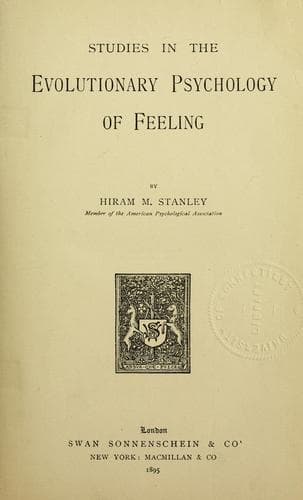
Studies in the Evolutionary Psychology of FeelingStanley, Hiram Miner
Philosophy
Studies in the Evolutionary Psychology of Feeling
Stanley, Hiram Miner
Emotions
There are, of course, many degrees of interest. Often interest is so
slight as not to rouse attention, being too weak to overcome natural
inertia to will effort or unable to deflect will as bent by some
conflicting interest. A lesson is to be learned, but the interest,
often extrinsic, does not rise to attention point till possibly a
few minutes before recitation. The interest, fear of failure, may
then be sufficiently strong to induce very vigorous attention, and
within a certain range the stronger the interest, the stronger the
attention. Yet at a certain point of intensity emotion begins to
derange will activity and to hinder and even destroy attention. Fear
which has become fright extinguishes attention. Self-controlling
power of attention is lost in a flood of emotion. Yet ungovernably
intense emotion is no longer properly termed interest, which always
implies cognitive power. Interest is properly comparatively mild
emotion state, which includes definite cognitive element. But
interest may be not only at or below attention point, but it may be
of such an intensity and kind as to do away with need of attention,
securing a spontaneous, or practically spontaneous, cognition. Thus,
my interest in a book may at first be insufficient, _i.e._,
practically _nil_, to constrain attention in any degree; it may
become so strong that I make constant cognitive effort, and finally,
as it becomes profound and absorbing, I cognize without any
attention. When anything becomes sufficiently interesting, interest
acts of itself directly upon cognition, which is then performed
without attention. Interest frequently increases to the spontaneous
cognition point, carries cognition in it; but we must remember,
nevertheless, that all cognition had its origin in attention.
Interest acquired and become habitual demands less and less force of
attention, so that our customary interests finally awake cognition
without any attention act. If given cognitions always required the
original will effort,—attention,—intellect could not progress,
delicate and far-reaching reactions could not be initiated, for they
could have no basis. The force of inherent hereditary interests
makes itself felt throughout all advanced psychic life. A survey of
the cognitions of any single day would show us that by far the
greater number are by this type and degree of interest. The common
cognitions and adjustments of every-day life in walking, sitting
down, and in matters of routine, are mostly of this type.
Public-domain text, read in full here on John Shaqi.
Reviews
Reviews
No reviews yet
Be the first to share your thoughts on this work.
Elsewhere in the archive
Join the Discussion
Join the discussion
Sign in to leave a comment or review.
Sign InorCreate an account