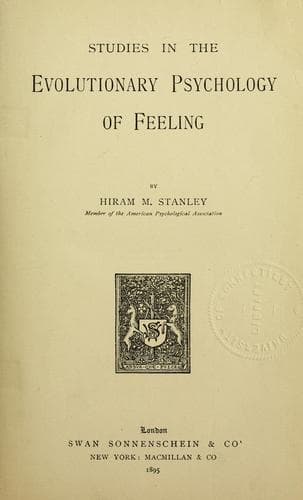
Studies in the Evolutionary Psychology of FeelingStanley, Hiram Miner
Philosophy
Studies in the Evolutionary Psychology of Feeling
Stanley, Hiram Miner
Emotions
It is tolerably plain that the relation of feeling to cognition cannot
be expressed by any single formula, and it is certainly far from true
that sensation or other cognition is inversely as the intensity of
feeling. If feeling, either as simple pleasure-pain or as interest, is
the incentive of attention, which is the primary measure of cognition;
then intensity of cognition is directly as intensity of feeling for a
certain range, and this is also true where attention has lapsed. The law
of inverse ratio applies only when feeling has risen beyond the point of
highest efficiency, when there is over pressure, and mind runs wild
beyond self-control and attention. Then we should, of course, find at a
certain point, if we could make exact measurement, geometrical decrease
in cognition for arithmetical increase in feeling, but ratio would
constantly change. The centre and spring of any high psychic life is
interest, and as interest increases intellection and volition increases
_pari passu_. In cases of decline, where interest or capacity for
emotion is lost, psychic life as a whole dissolves and disappears. On
the contrary, the progress of mind is in the strengthening and extension
of interest.
Interest leads to attention in the forms mentioned, but it seems also a
mode of attention when, at the bidding of interest, we not only promote
or inhibit some cognition, but some particular feeling. In a fit of
anger we may be prompted by prudence or conscience to forcibly and
directly restrain and abate it. I may similarly maintain an amiable
frame of mind as opposed to crossness. To repel a fit of anger of course
implies repelling the representations which enter into the angry
emotion, and so it is that the repressing or stimulating all emotions,
by reason of their representative nature, necessitates a will effort
with reference to the cognitive element, and thus an attention.
Public-domain text, read in full here on John Shaqi.
Reviews
Reviews
No reviews yet
Be the first to share your thoughts on this work.
Elsewhere in the archive
Join the Discussion
Join the discussion
Sign in to leave a comment or review.
Sign InorCreate an account