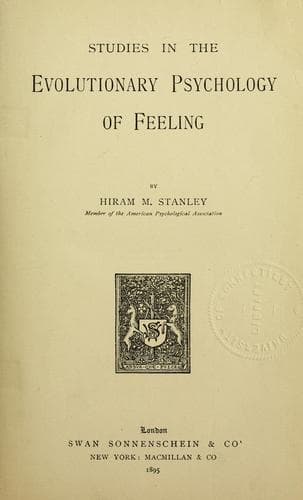
Studies in the Evolutionary Psychology of FeelingStanley, Hiram Miner
Philosophy
Studies in the Evolutionary Psychology of Feeling
Stanley, Hiram Miner
Emotions
Assuming then psychism as mode of adaptive reaction, we see the
necessity for the correlation of the sense of self with the sense of
things. An experiencer blind to self, who has no awareness of self, but
merely blindly strives, has little advantage, for it possesses no
self-directivity and no power of intelligent action. Its adaptation is
purely general; to be specific adaptation it must appreciate differences
in environment in their differential action upon itself, an appreciation
of the objective in subjective terms. It is probable then that the first
knowledge was the apprehension of thing as painer and then of the thing
as pleasurer. A discrimination of the two is attained, probably tactile,
as hard and soft. The subjective import of the thing is at once realized
from these signs.
It is obvious that the origin of self-consciousness must be placed very
early in psychic life. With organisms which have but a few flashes of
consciousness during their whole individual existence, whose whole
experience is a mere sum of separate pleasure-pain thrills and blind
efforts, there is neither sense of objectivity nor subjectivity. These
very lowest psychisms have experience, but no sense of experience;
pleasures and pains possess them, but they do not possess these. But if
mentality arises and progresses solely by virtue of its function in
saving and profiting the individual living organism, if the end of
psychosis is this self-conservation of the bodily whole in its vitality,
there is an imperative demand for self-cognizance in order to self-care.
Under the law of struggle and survival of the fittest, the organism
which does not look out _for itself_ must go to the wall or be in the
lowest grade. Self-conservation is closely linked with self-sense. Hence
the individual very early acquires some sense of itself in its
environment, and so acts and conducts itself. Thus under adverse forces
it learns to know itself, to realize its own place and power, and to
feel fear, anger, and so to appropriately respond to any environment.
Thus is secured manifold and special response to multiform conditions,
whereas in the organism which has only pure subjectivity of pain the
response would be uniform.
Public-domain text, read in full here on John Shaqi.
Reviews
Reviews
No reviews yet
Be the first to share your thoughts on this work.
Elsewhere in the archive
Join the Discussion
Join the discussion
Sign in to leave a comment or review.
Sign InorCreate an account