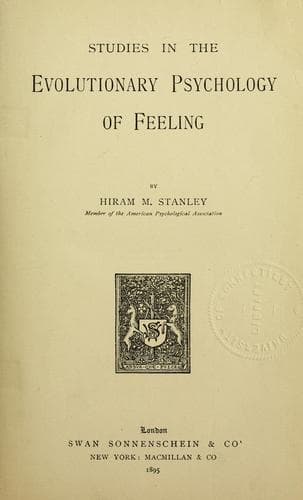
Studies in the Evolutionary Psychology of FeelingStanley, Hiram Miner
Philosophy
Studies in the Evolutionary Psychology of Feeling
Stanley, Hiram Miner
Emotions
from asserting that all cognizings with pain are attentions.
CHAPTER XV
_SELF-FEELING_
Popular and scientific observation agree that a very interesting and
important phenomenon in consciousness is the sense of self as involving
such feelings as pride, shame, self-satisfaction, and self-disgust. And
the evolutionary psychologist is bound to consider self-consciousness in
its rise and development as a life factor. What is its significance for
life? How and when did it arise as answering a demand in the struggle
for existence? Further, the psychologist is bound to clearly define and
analyse the self-sense as psychic fact, to understand just what it is,
as well as what it seems. The nature of the self-sense must be carefully
studied by introspection, and its elements and quality determined.
However, the psychist has nothing, of course, to do with the self which
is sensed, an inquiry which belongs alone to the metaphysician.
Self-consciousness has been throughout all our discussion assumed and
implied as factor in emotion life. Object is not merely perceived, for
this in itself has no life value, but is at once interpreted in
experience terms, is self-related, and emotion arises and stimulates
suitable will-response in bodily activities. Thus all response to
environment through cognition of environment means with sense of the
environment as its own. Thus, and thus only, is sense of environment
rendered efficacious, for bare objectivity, which signifies nothing, has
no value for life. Under the conditions of existence in the struggle of
life object cognition could not originate because it has no function.
The theory of natural selection then requires that object and subject
cognition be regarded as complementary psychic factors, coincident in
their origin, and developing in strict correlation.
This corollary from the theory of natural selection, implying a
self-relating act in all cognition under the condition of struggle for
existence, is seen to be a likely hypothesis so far as we can judge from
the action of low psychisms. Any one who closely observes animals must
recognise that self-interest determines their cognitive activities and
in turn is roused by it. The alert listening and looking of a squirrel
is obviously impelled by fear and awakens fear. The object perceived is
constantly interpreted for its experience value, that is, there is
constant self-reference. This is the type of all cognition under natural
selection, _i.e._, where use dominates.
Public-domain text, read in full here on John Shaqi.
Reviews
Reviews
No reviews yet
Be the first to share your thoughts on this work.
Elsewhere in the archive
Join the Discussion
Join the discussion
Sign in to leave a comment or review.
Sign InorCreate an account