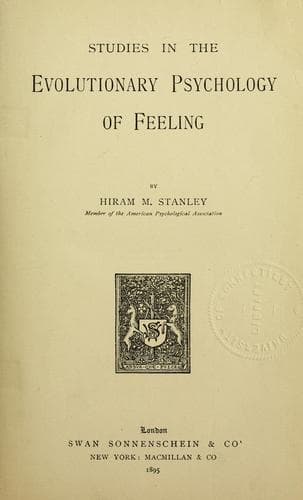
Studies in the Evolutionary Psychology of FeelingStanley, Hiram Miner
Philosophy
Studies in the Evolutionary Psychology of Feeling
Stanley, Hiram Miner
Emotions
The primitive self-consciousness is evidently naïve, that is, there is
no consciousness of the self-consciousness. The low psychism is
conscious of itself, knows what is to its own advantage, and is
absorbingly selfish, but it is wholly unconscious of its self regard; so
also with very young children we see an egoism which is perfectly
unconscious and naïve, often humorously so to the observant adult who
perceives the utter simplicity of its selfishness. The embarrassing
self-consciousness of the boy and girl in their teens, a conscious
self-consciousness, is not yet achieved. The immediate consciousness of
self cannot by itself embarrass, it must be complicated with reflection
and with cognizance of other _ego_'s; but later forms we do not need to
discuss here.
In the simplest form of self-consciousness what are the necessary
elements? and what is the essential nature of self-consciousness as
psychic fact?
In the first place, then, what is the nature of self-consciousness as
cognition? If cognition be awareness of object, what is self or subject
cognition? Is subject merely a kind of object? Is self-consciousness a
peculiar conscious mode, or is it merely of the same type as the general
cognition of object? Of course we wish to consider such questions here
simply in the light of psychic fact.
It is often considered that self-cognitions are really in no way unique,
that the subject sensed is merely the individual’s body or his mental
powers. And it is undoubtedly true that subject is always some object,
the subject cognition is apprehension of some object either corporeal or
mental; yet self-cognition is never merely an object seen as object. The
psychic act of self-cognition is a peculiar qualifying of the object
cognition; the individual who merely knows body or mind has not
self-sense, he must be aware of body and mind as his own. The essence of
self-sense is not in the object as so perceived, but in the
subjectifying reference. While the _ego_ then is always constituted as
object, _ego_ sense as psychic fact is more than mere object cognition.
The psychic self as object, as some mode or modes of consciousness, has
naturally been emphasized. Thus the self may be defined as that which is
subject to will. Yet the least reflection shows us that for self-sense
this must imply _my_ will, and so assume what it would explain. A
consciousness of will act as effective psychic fact is not _ego_ sense.
A cognition of effort or _nisus_ is not the sense of self save so far as
the effort is known or felt as _mine_. And so in any other objectivist
definition of self as psychic object, the self in its real nature as
psychic act vanishes. Thus the consciousness of pleasure-pain capacity,
while closely related to self-sense, does not make it, for we have to
add that the capacity must be known as one’s own. In every endeavour
then to define or analyze the self as psychic fact we must either
eliminate it or presuppose it, and this must be taken as very
Public-domain text, read in full here on John Shaqi.
Reviews
Reviews
No reviews yet
Be the first to share your thoughts on this work.
Elsewhere in the archive
Join the Discussion
Join the discussion
Sign in to leave a comment or review.
Sign InorCreate an account