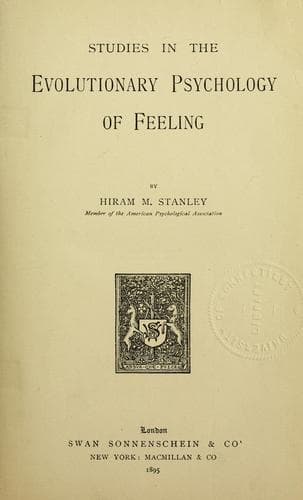
Studies in the Evolutionary Psychology of FeelingStanley, Hiram Miner
Philosophy
Studies in the Evolutionary Psychology of Feeling
Stanley, Hiram Miner
Emotions
significant. It means at least that this _stating_ it—being merely
objectifying act—destroys the subjectifying which is its essence. The
radical distinction and polar opposition of subjectifying and
objectifying is therein suggested, and the difficulty of all fruitful
discussion and scientific investigation, which is objectifying, is made
apparent.
The objective cognition of a self can only mean cognition of an object
capable of experience. Objects are thus discriminated into two
classes—experiencers and non-experiencers, subject-objects and bare
objects; but this is not self-sense whereby the experiencer directly
knows _his own_ experience as such, but merely sense of a self as any
individual object experiencing. This objective definition of a self is
simple enough. It merely asserts that any object which at any moment of
its persistence or existence has a consciousness or experience of any
kind is thereby a self. But this is obviously not a definition of the
self and self-sense as psychic act, nor does it explain it. The
scientific statement that individual objects exist as experiencers, and
so are personalities, or _ego_'s, does not clear up the self-sense
whereby the individual is aware of his own individuality as such.
Egohood as selfishness in this objective sense, and ego-hood as
self-experience, as a feeling and knowing myself, are quite distinct. To
the question, What makes an object—this particular object, body with
limbs and various organs capable of feeling pain-pleasure—what makes
this _myself_? the only answer is relation not, be it noted, to
experience, but to _my_ experience felt as such. And what makes an
experience mine is that I consciously experience it; not merely that I
experience—that experience occurs to me, or in me, as objective fact—but
that I consciously experience, subjectively realize the experience as
_mine_; not merely as realizing experience as experience, but as _mine
own_. This ceaseless circle into which we fall in trying to define _ego_
is hinted at in various common expressions. A child even will often
remark, “I did not do it, my hand did it”; “you did not touch _me_, you
touched my _foot_,” etc. That is, even the most cursory observation
asserts that object in itself is not subject, that the me is not mine.
While, then, we must regard self-cognition as a _genus_ by itself and as
unanalyzable simple psychic fact, arising early upon a very slight basis
of experience, and continually developing as most important psychosis
for life, we may yet distinguish what is involved with it, what modes of
consciousness it presupposes, and from which it yet is distinct.
Public-domain text, read in full here on John Shaqi.
Reviews
Reviews
No reviews yet
Be the first to share your thoughts on this work.
Elsewhere in the archive
Join the Discussion
Join the discussion
Sign in to leave a comment or review.
Sign InorCreate an account