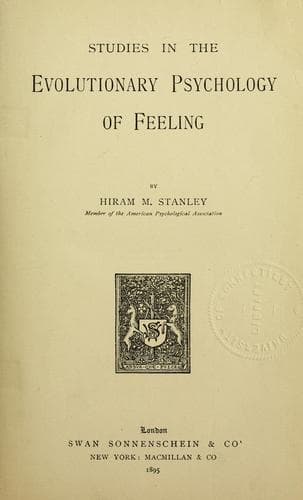
Studies in the Evolutionary Psychology of FeelingStanley, Hiram Miner
Philosophy
Studies in the Evolutionary Psychology of Feeling
Stanley, Hiram Miner
Emotions
The close connection of self-consciousness with consciousness of
consciousness leads often to their confusion. Thus under the head
“Illusions of Self-consciousness,” J. M. Baldwin, in his treatise on the
Senses and Intellect, says, “Of these subjective illusions we may
mention _emotional illusions_, wrong estimates of our emotional states,
as when an angry man declares that he was never more cool in his life.”
This instance is plainly an illusion of introspection, not of
self-inspection; there is a mistake in the consciousness of
consciousness. Wundt, in defining self-sense as perception of the unity
of experience, falls into the same confusion.
It points to the fundamental value and place of these cognition factors,
that when we say any one is conscious we imply them all. Thus I say of
some one rendered unconscious by an accident, “He slowly recovered
consciousness,” by which I mean, became aware of himself and his
surroundings with awareness of his own mental activities. He is
consciously conscious, objectively conscious, and self-conscious. All
this makes up for us being conscious, and is for cognitive mind such a
simple organic basal movement as circulatory-nervous-motor function is
for body.
An organism must, of course, have had some psychosis before it can
become conscious of it, and of it as its own, and this primitive
psychosis we regard as pure pleasure-pain series. But in the struggle
for existence the organism is driven out of this subjectivity to
cognize its environment as related to itself, to apprehend and
comprehend and so to feel about itself—emotion—and so led to
intelligent will activity as real self-activity. At the very first the
organism has pleasures and pains, without knowing them as determined
in itself by objects, but this primitive pre-cognitive stage is short,
and most psychisms are certainly beyond it; they sense and notice
things, bodily and beyond the body, as of experience value in pleasure
and pain terms. At some most critical moment cognition first arose as
triple movement, object—subject—consciousness knowledge. Just what may
have been its original form it is most difficult to determine, but we
may suppose it to have been a very weak activity, possibly
expressible, as, “it hurts,” object being simply pain centre. “It
hurts,” means object self-related, with consciousness of the
consciousness, and this is our language expression for what seems to
be an extremely common psychosis among many organisms. As simple pains
were probably the first conscious phenomena, consciousness of pain was
probably the first consciousness of consciousness, involving also
subject and object consciousness. Not only to have a pain, but to be
conscious of it as definitely objectively determined is decidedly
useful attainment, which is finally inground in experience, so that it
occurs spontaneously in highest psychisms. But it is only with a few
of the highest human psychisms that consciousness object and subject
Public-domain text, read in full here on John Shaqi.
Reviews
Reviews
No reviews yet
Be the first to share your thoughts on this work.
Elsewhere in the archive
Join the Discussion
Join the discussion
Sign in to leave a comment or review.
Sign InorCreate an account