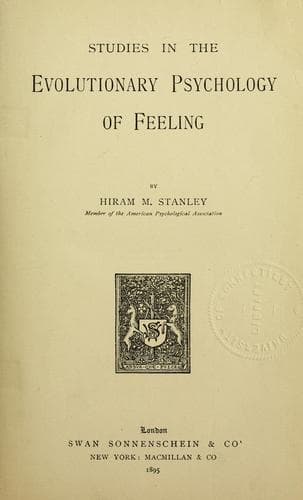
Studies in the Evolutionary Psychology of FeelingStanley, Hiram Miner
Philosophy
Studies in the Evolutionary Psychology of Feeling
Stanley, Hiram Miner
Emotions
We might speak of ego-sense as an experience knowing itself. But since
cognition implies always a knowing and the known, an experience cannot,
and does not, know itself. The consciousness knowing is never the
consciousness known; and to speak of a consciousness as aware of itself
is misleading and inaccurate. To speak of the cognizance of a pain as
pain self-cognizant is an erroneous expression, for the pain does not
know itself; but it is known by a cognition which is not it. To be aware
of pain as such is awareness of consciousness, but is, interpreted
strictly, in no wise self-consciousness. I may even speak of a
self-conscious self-consciousness. This does not really mean what it
directly implies, but can only mean a self-consciousness _plus_ a
consciousness of it as one’s own; that is, the self-consciousness is not
actually conscious of itself. Even if a consciousness could both be and
know its being as an absolute, simple act, yet this would not be
self-sense, an individual realizing its own individuality, but merely a
single psychic act existing, and at the same time conscious of its
existence. Self-consciousness is more and other than any consciousness
which is self-conscious, if that were possible.
Consciousness of consciousness is not, then, self-consciousness. It is,
indeed, conceivable that an _ego_, in objective sense, might know his
own consciousness not as _his own_—the act of self-consciousness—but
merely as consciousness, and he would thus exist as an individual, yet
without subjective individuality. Yet, as matter of fact, consciousness
of consciousness always carries self-consciousness with it. If I become
conscious of a consciousness which is my own, I know it, not merely as a
consciousness, but as my own consciousness; if I am conscious of anger,
I am conscious of being angry.
Hume, in his chapter on Personal Identity, observes, “For my part, when
I enter most intimately into what I call _myself_, I always stumble on
some particular perception or other of heat or cold, light or shade,
love or hatred, pain or pleasure. I never can catch _myself_ at any time
without a perception, and never can observe anything but the
perception.” This is a good illustration of a futile and mistaken
attempt to absorb self-consciousness in consciousness of consciousness.
Of course Hume was not the hypothetical _ego_ which we have instanced as
purely objective observer of his own consciousness; when he was
conscious of any consciousness, as a heat or light sensation, a pleasure
or a pain, he was assuredly, like other mortals, conscious of it as his
own. The sense of mine-ness as psychic fact he should not have ignored,
whatever might be his conclusions as to the _myself_ But metaphysical
psychology is always apt to swerve from fact.
Public-domain text, read in full here on John Shaqi.
Reviews
Reviews
No reviews yet
Be the first to share your thoughts on this work.
Elsewhere in the archive
Join the Discussion
Join the discussion
Sign in to leave a comment or review.
Sign InorCreate an account