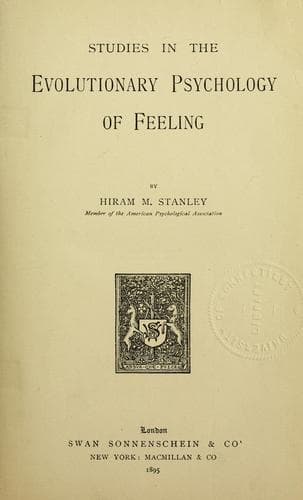
Studies in the Evolutionary Psychology of FeelingStanley, Hiram Miner
Philosophy
Studies in the Evolutionary Psychology of Feeling
Stanley, Hiram Miner
Emotions
When an object is to be competed for, but we consider it beneath us to
enter the lists, or we think our rivals unworthy of our attention, we
have the peculiar phase of feeling termed arrogance. Arrogance brooks no
rivalry and stands apart on a peak of self-contained superiority. Walter
Savage Landor, the proudest of men, displays this feeling in perfection
when he says in one of his cameos in verse:
“I strove with none,
For none were worth my strife.”
This is a perfect expression of complete arrogance. We may say that he
was too proud to be proud. No one was worthy of his mettle, and so he
held himself aloof with the feeling of immeasurable superiority.
Strictly speaking then, arrogance is a variety of very intense pride
where the sense of superiority is perfectly exclusive and absolute, and
disdains comparison. It is entirely inconsiderate of others’ rivalry and
above caring for the approval or disapproval or admiration of others.
Thus this phase, unlike pride in general, seeks concealment rather than
display; its excellence is so far beyond the common as to be
unappreciable by contemporaries, and appreciated by self alone.
Conceit is a term objectively applied, but hardly indicates a kind of
pride, a real subjective distinction. He who thinks more highly of
himself than he ought to think, esteems himself beyond his due, and so
is considered by the community over proud, is termed conceited. The
pride which is entirely just, as viewed from the objective standpoint,
is quite the same subjectively as the most preposterous conceit.
Similarly also dignity is no real feeling. “That man is dignified”; this
is an objective characterization of his manner of conduct, but this does
not imply that he feels dignified. Pride may give a dignified demeanour,
but a feeling dignified can only refer to the reactive effect upon
consciousness, of this mode of behaviour. “I feel proud,” may likewise
sometimes be used, not for designating the subjective feeling or being
proud, but as equal to, “I felt that I was proud,” that is, “I was proud
and I knew it,” “I had the sense of being proud.” So also in general we
may remark that while feeling may denote a simple state of being, yet
such phrases as “I felt proud,” “felt angry,” etc., are ambiguous, and
may mean either the bare feeling of pride, anger, etc., as experienced,
or the feeling of being proud, angry, etc., or both, that is,
consciousness of the particular consciousness may or may not complicate
self-consciousness. The word, feel, is often used in this merely
reflexive way to denote a sense of state as, “I was proud and I felt so
at the time.” Thus common phrase verifies the analysis that
self-consciousness and consciousness of consciousness are bound up with
emotion, the full analysis of the phrase showing that the feeling proud
was an object consciousness _plus_ a subject consciousness.
Public-domain text, read in full here on John Shaqi.
Reviews
Reviews
No reviews yet
Be the first to share your thoughts on this work.
Elsewhere in the archive
Join the Discussion
Join the discussion
Sign in to leave a comment or review.
Sign InorCreate an account