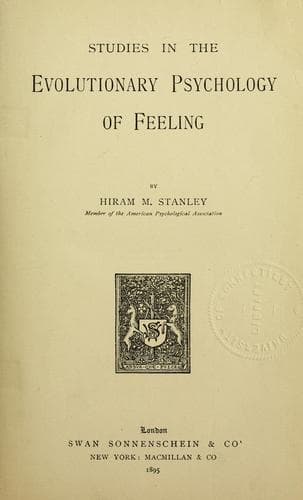
Studies in the Evolutionary Psychology of FeelingStanley, Hiram Miner
Philosophy
Studies in the Evolutionary Psychology of Feeling
Stanley, Hiram Miner
Emotions
As previously intimated, we have to sharply distinguish between pride
and such emotions as self-satisfaction and self-complacency. These
latter emotions of personality deal solely with the self in its own
sight, while pride is always not over self to self, but over self to
others. The self-satisfied often are proud, but this is not necessarily
implied. The comparative element enters in self-satisfaction, as in all
true pride, but the comparison is primarily with oneself, not with
others. If we succeed in our own eyes, we may think little about others.
A pure self-satisfaction, like a purely altruistic pride, is a rare and
late phenomenon. Pride about others, pride to oneself, are both very apt
to be tinged with the original pride over others. One says of a friend,
“I feel proud of him”; but while this has a certain reality and psychic
value of altruistic mode, yet the innate and fundamental selfishness of
pride tends to make a place in what appears to be the most disinterested
form. Personal interest and aggrandisement is so inbred a motive from
the earliest stages of evolution that it is never superseded.
A feeling of embarrassment is an emotion of personality which is closely
connected with pride. Those who are most susceptible to pride are most
apt to feel embarrassed. The one who has no tendency toward pride, who
does not in the least care how he may appear before others or in
relation to others, and so does not value his place among his fellows,
cannot be embarrassed. He may be disturbed by the difficulties of some
task, but only in the same way in which he would be agitated by any
difficult work undertaken by and for himself alone. The emotion of
embarrassment, like pride, conceives the self in its social relations.
When one says that he felt greatly embarrassed in being called on
unexpectedly to speak at a dinner, we perceive that he means emotion,
not merely in view of the inherent difficulty of the task, but in view
of what he himself may or may not do under the inspection of the
critical. In this emotion there is a wonderful quickening of the
self-sense, a painfully intense self-consciousness being suddenly
generated as the peculiar relation of self to others is impressed upon
him. This self-sense is powerfully reinforced by the self-sense of the
bodily expression of self-consciousness. The whole bodily self seems
conspicuously magnified, and we become painfully aware of hands, feet,
and other members. This bodily self-sensitiveness, as often contributing
strongly to this emotion-total, is very marked in cases of blushing. A
girl, feeling embarrassed, blushes, and immediately becoming conscious
of the blushing as itself an embarrassing circumstance, blushes again
still more violently, and becoming conscious of this, becomes still more
confused, and so on, a constant cumulation of psychic effect from
reaction of expression. Sense of the expression of embarrassment is
Public-domain text, read in full here on John Shaqi.
Reviews
Reviews
No reviews yet
Be the first to share your thoughts on this work.
Elsewhere in the archive
Join the Discussion
Join the discussion
Sign in to leave a comment or review.
Sign InorCreate an account