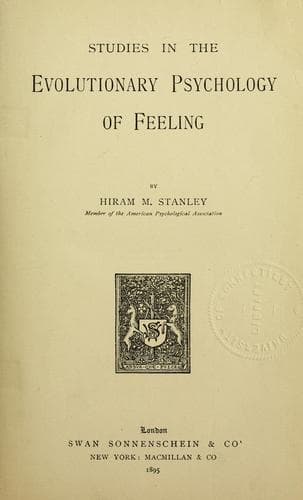
Studies in the Evolutionary Psychology of FeelingStanley, Hiram Miner
Philosophy
Studies in the Evolutionary Psychology of Feeling
Stanley, Hiram Miner
Emotions
specimens of mankind renounce the “world,” “the lust of the eye and
pride of life,” and live by their self-erected ideals. And if we ask how
the spirit of humility and disinterestedness can arise and progress in a
natural evolution, we must answer that it holds its place and wins its
way by reason of its greater inherent value and fruitfulness. He who has
himself in view has lost sight of his work. By this psychic mode alone
is the largest, most perfect, most permanent work accomplished, and
ultimately, often posthumously, it is appreciated at its real worth.
Those originating and master minds in human history who have opened new
avenues of spiritual progress, have usually been of this modest,
unassuming, humble type. Thus in a wholly natural manner the higher law
of an ideal life prevails over the lower law of life which works only by
competition in the struggle for existence.
CHAPTER XVI
_INDUCTION AND EMOTION_
We have implied throughout that we have feeling about a thing only so
far as we attach on basis of past experience an experience value to the
thing, as we say, “the burnt child dreads the fire.” Induction, as this
interpretation is termed, is so important an element that we will devote
a little space to considering its _rationale_, development, and place in
intellectual emotion.
What is the _rationale_ of the inductive act? Why should iteration lead
to expectancy of reiteration? I observe that a body unsupported falls in
a hundred instances, but is it not arbitrary for me then to suppose that
it will fall the hundred and first instance? In fact would it not be
more rational to suppose that this particular combination should be
exhausted, that it was time for nature to stop? But this very reason
rests on the uniformity of nature—the very law we are questioning—as
experienced in the past and applied to the future; only it is a negative
law of omissions, literally law of reiteration of unreiterations. Thus
if reason takes the law of uniformity of nature to task it can only do
so by assuming it. J. S. Mill in his treatment of this matter (_Logic_,
bk. iii. chap. 3, sec. 2), falls into an error. It is, indeed, true, as
he says, that some occurrences repeated suggest cessation and not
recurrence, as when we have several consecutive cloudy days, we expect a
bright one, or having had several rainy seasons we expect a dry one; but
it is plainly wrong to regard this, as he does, as a contradiction of
the principle of uniformity of nature. On the contrary, this is a very
good example of it. Experience of intermittent character of bad weather
in the past leads to expectancy of its re-intermittency for the future,
and the oftener the experience the stronger the belief as to the nature
of the still unexperienced. A negative uniformity is as much a
uniformity as a positive.
Public-domain text, read in full here on John Shaqi.
Reviews
Reviews
No reviews yet
Be the first to share your thoughts on this work.
Elsewhere in the archive
Join the Discussion
Join the discussion
Sign in to leave a comment or review.
Sign InorCreate an account