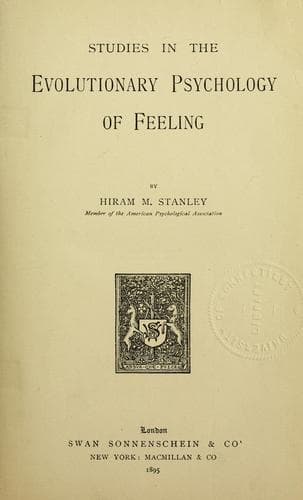
Studies in the Evolutionary Psychology of FeelingStanley, Hiram Miner
Philosophy
Studies in the Evolutionary Psychology of Feeling
Stanley, Hiram Miner
Emotions
It is plain that we can assign no reason for our belief in the
uniformity of nature. It is simply a fact, an arbitrary fact if you
will, that the more often experiences are conjoined, the more strongly
we expect the conjuncture. I may imagine a body unsupported remaining
stationary in the air as readily as to imagine it falling; however, I
_believe_ it will fall, and I duck my head for fear of getting hurt. Not
any speculative reason then, but a very practical reason, is at the
bottom of this inductive tendency, that is, the conservation and
progress of the organism is secured by induction as anticipatory
function. The origin of induction is not then in its abstract
rationality, but in its immediate utility as a life function. Experience
is self-adjustment through felt stimulus. Once begun it grows by
continual self-reference, and hence practically all experience is
inductive. Experience is thus a _continuum_, an integrating cumulating
whole; and inductive experience, like all experience, arises and
progresses by reason of its serviceability.
It has been implied that the inductive act arises very early in the
history of experience. Every psychosis is what it is by reason of all
the previous psychoses in the individual and the race. Psychism, while
it has its points of development in individuals, must yet be estimated
as a unit, as a single whole. But we have to ask whether this
modification of one psychosis by another is conscious or unconscious. If
some low organism have in its lifetime but two consciousnesses, must we
regard the second as influenced in quality by the first, and if so,
consciously influenced, that is, a conscious relating, an active
induction as opposed to mechanical integration? Is mind always
self-building, or does psychosis act and react on psychosis
automatically? We have maintained that all the growth of mind has been
in the past, as in the present, by struggle, by severest endeavour, and
hence if experience modify experience it is by conscious act. Experience
thus constantly connects with itself and builds upon itself, it is
self-integrating, that is, inductive, in all its evolution. Mind, as
primarily pleasure-pain and struggle, by endeavour reaches back to
itself, realizes itself, and rises upon itself.
Public-domain text, read in full here on John Shaqi.
Reviews
Reviews
No reviews yet
Be the first to share your thoughts on this work.
Elsewhere in the archive
Join the Discussion
Join the discussion
Sign in to leave a comment or review.
Sign InorCreate an account