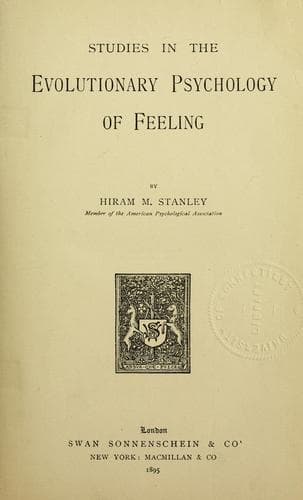
Studies in the Evolutionary Psychology of FeelingStanley, Hiram Miner
Philosophy
Studies in the Evolutionary Psychology of Feeling
Stanley, Hiram Miner
Emotions
The rise of generalizing power is through the struggle for existence; it
originates, like all other mental processes, in practical needs. Law is
thereby not simply acted upon or merely recognised, as in the
associative stage: it is definitely sought for and applied. Art arises,
and also science. The ability, given by generalizing power, of dealing
with things in the lump, becomes of signal service, and specially
distinguishes man. But the primary value of the concept in all its
stages is not as a summation of experience, but as a guide for the
future. Through reiterated grouping the concept-group is recognised as
permanent factor, so that one element of a group being given, other
elements are expected through a conscious assimilation with the past
experience. The concept answering to the word orange, for example, is
the mental product recognising a constant co-existence of certain
qualities of shape, colour, size, taste, etc., so that from occurrence
of one or more we infer other or others. Concepts are the inner
groupings, the mental synthesizings, which interpret the outer groupings
that we term laws of nature. In all this we see the inductive element in
its conscious form, experience developing itself by anticipating future
in terms of past.
We have now to consider briefly the psychological nature of judgment and
reasoning with special reference to the inductive feature. Logically
judgment is any connecting, _plus_ affirming of reality, as effected
through the copula. The copula is made, not only to denote relation, but
reality of relation, to express, not only the act of connecting, but
also its validity for the case in hand. Psychologically, judging may be
regarded as any thinking, as any relating without reference to the
things related, whether it be a joining of the concept “reality” to some
other concept as a concept-forming process, or any joining of other
elements. I have already discussed the nature of relating _per se_, but
on the topic of judgment a word is to be said about the
proposition-form. In all thinking there are the two things
joined—subject and predicate in language-expression—and the act of
joining, or copula in language-expression; thus all thought is capable
of the proposition-form. Indeed, the word-form cannot express a thinking
but only a thought as a consolidated and single product, and as a sign
of process. The word is a summary of process and relations, but it
cannot express process as concept-forming or judging. The word orange
signifies for the mind by symbolic and shorthand method, “Thing is sweet
_plus_ thing is yellow,” etc; but as far as process happens, and not
simultaneous composite representation, the process is capable of
proposition-form. All relatings or joinings, even of particulars to
particulars, are of the proposition-type, and I must dissent from the
common view that two percepts cannot stand in subject-predicate
relations. As I have before discussed, the relating of particular to
Public-domain text, read in full here on John Shaqi.
Reviews
Reviews
No reviews yet
Be the first to share your thoughts on this work.
Elsewhere in the archive
Join the Discussion
Join the discussion
Sign in to leave a comment or review.
Sign InorCreate an account