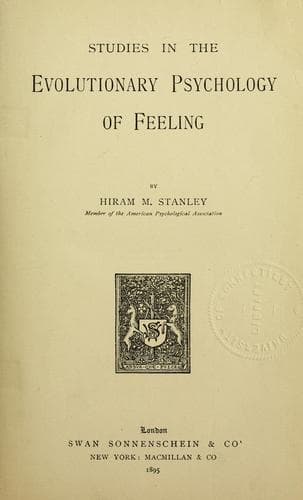
Studies in the Evolutionary Psychology of FeelingStanley, Hiram Miner
Philosophy
Studies in the Evolutionary Psychology of Feeling
Stanley, Hiram Miner
Emotions
How then does the child come to knowledge of things as like, to form a
class of oranges after regarding all oranges as the orange? Pass oranges
before a young child one after the other so that one only is in sight,
and the child will probably know only one orange as the same continually
re-appearing. The image formed will, however, be more or less composite,
the mental product will be a concept-image, as being a re-inforcement
and exaggeration of common characters and a suppression of individual;
but for practical purposes it is still a particular concept, that is,
the child applies it to the one and not the many, and does not recognise
its representative nature. A general image as a group of common
qualities may be thus attained before consciousness of this generality
is reached.
If now two or three oranges are presented to the child at the same time,
it will learn to discriminate them as separate co-existences, having
characters in common, roundness, yellowness, etc.; the objects will be
recognised as individuals belonging to class round-yellow things. Here a
general image having a general import is achieved. The particular
characters, round, yellow, sweet, which always centred in and made up
the individual orange, are recognised to have general scope in applying
to many objects. Groups of characters had been achieved before by
particular thinking, but now by general thought groups of characters as
common are formed. From the practically coincident impressions it gains
the notion orange, so that it recognises new individuals as individuals,
and not as the individual or single object, as in the earlier and cruder
identity method of thinking. The mind now—instead of saying “Same
impressions, same object”—says “Same impressions, like objects.” Instead
of making an object as a group of qualities, it makes a class of objects
having the group of qualities in common. Concept-forming is thus often
but an extension from what I have termed the particular concept; the
group of qualities formed as characterizing the thing is through
experience with co-existences predicated of things. Notion or idea of
the orange precedes notion or idea of orange; but both are truly notions
or concepts, a taking together of impressions, one of particular, the
other of general import. The general significance of the particular
group is first forced upon the mind by experience, but soon the mind
generalizes as well as notices generalizations brought to it. Gradually
the mind obtains power to generalize, not only from co-existences, but
from successions, and later still to generalize by abstraction, to
compare and pick out common features amidst the unlike, to search for
unity in diversity.
Public-domain text, read in full here on John Shaqi.
Reviews
Reviews
No reviews yet
Be the first to share your thoughts on this work.
Elsewhere in the archive
Join the Discussion
Join the discussion
Sign in to leave a comment or review.
Sign InorCreate an account