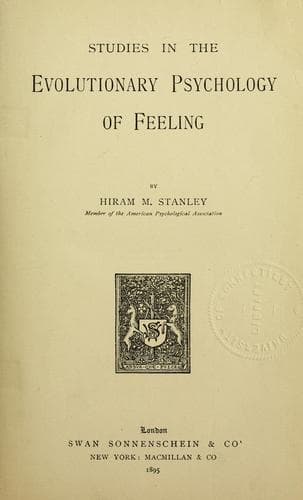
Studies in the Evolutionary Psychology of FeelingStanley, Hiram Miner
Philosophy
Studies in the Evolutionary Psychology of Feeling
Stanley, Hiram Miner
Emotions
The problem of the origin and nature of æsthetic feeling is a definite
psychological problem to be solved only by introspection careful and
prolonged. We must take simple cases and closely scrutinize them to
discover the distinctive quality, we must seek the cognitive, feeling,
will elements, we must note its kinship to other psychoses, we must
endeavour to analyse and determine whether it be simple or complex.
Analysis, indeed, as chemical analysis, _e.g._, is a reducing the
manifold to a comparatively few elements, from which by composition an
indefinite number of substances are formed. But in psychological study
we must proceed without any bias from physical investigation. We cannot
reduce mind to the mechanical development of a few simples as we survey
the development of matter chemically. If mind be essentially
self-activity, will effort, then conjunction of psychoses is due to a
conjoining activity, and is not mere aggregation. So in case of fear we
found a great complexity of conditions, yet fear in itself seems an
unanalyzable emotion wave. In taking up æsthetic psychosis we attempt an
unbiassed introspective study.
The æsthetic psychosis has been by many evolutionists connected with
sexual appetite and emotion. The evidence for this is that among animals
the brilliant-hued, and, as we term them, beautiful mates are chosen in
pairing time. Also graceful movements and melodious tones are then
employed. In mankind the æsthetic feeling, as every one may recall in
his own case, arose, and became prominent when near or in the teens. The
rude boy and the hoyden girl then dress and adorn themselves, and a
glamour of beauty is thrown about one who was once an entirely
indifferent object. All the surroundings, artificial and natural, of the
beloved object are looked upon and thought about in a new way of
feeling, an air of attractiveness and beauty envelops all. The period of
life of strongest sexuality, from twenty to forty, is also the period of
strongest æsthetic emotion. Further, sexuality is notedly strong among
those who professionally cultivate the æsthetic psychosis, as artists,
musicians, and poets: indeed, many of the very greatest of these have
been so carried away by the tender passion as to transgress the
conventions and laws on sexual matters. In cases of precocious sexuality
a feeling for the beautiful makes itself apparent; while with those who
slowly mature, the æsthetic feeling is similarly delayed. But does not
the infant who holds out a rose to you and cries “pretty,” have a
feeling for beauty? And it is surely unaffected by sexuality. What may
be in the mind of a child speaking thus is hard to make out, but the
activity is probably largely mimetic merely, and the term “pretty” is
probably used substantively rather than qualitatively; it is the name of
thing rather than quality. We certainly cannot assert of a child that
because it uses certain words it attaches to those words the proper
meanings.
Public-domain text, read in full here on John Shaqi.
Reviews
Reviews
No reviews yet
Be the first to share your thoughts on this work.
Elsewhere in the archive
Join the Discussion
Join the discussion
Sign in to leave a comment or review.
Sign InorCreate an account