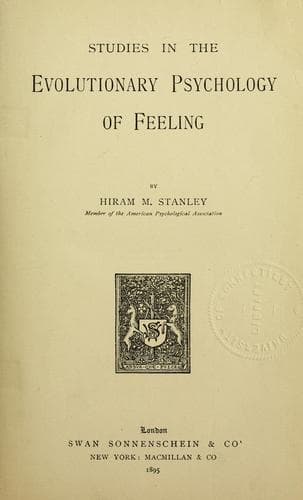
Studies in the Evolutionary Psychology of FeelingStanley, Hiram Miner
Philosophy
Studies in the Evolutionary Psychology of Feeling
Stanley, Hiram Miner
Emotions
This is evident from the fact that a child taught to say
“pretty” will bring you any and every object and use the word, or if it
learns to take merely a class of objects, as rose, it does this at
dictation. The child is, however, obviously attracted by some objects
rather than others, but it would be hasty to say that it perceives their
beauty, when it is quite sufficient to regard them as conspicuous only,
and striking. But we have to touch on sensing later; and we only add to
the evidence of connection of feeling for beauty with sexual feeling,
that with the old and with eunuchs the æsthetic sense is but slight or
tends to vanish. Thus positively and negatively there seems to be
evidence that feeling for beauty originates in connection with sexual
passion, either that the object of the passion is always regarded as
beautiful, or that a feeling for beauty excites the passion. A girl
adorns herself to attract lovers, knowing that to admire beauty is the
first step to love. This close connection is recognised in common
consciousness in that “lovely” is synonymous with beautiful, thus a
“lovely” landscape or picture is a beautiful one.
That there is a close association of sexual with æsthetic psychosis is
then obvious in the case of the human being, but yet it would be quite
hasty to conclude that a sweet note or a pure colour may not be
æsthetically appreciated by children before they have the first stirring
toward sexuality, but still it is very easy—as I have before noted in
the case of the child who cries “pretty!”—to mistake the quality of
their interest.
Public-domain text, read in full here on John Shaqi.
Reviews
Reviews
No reviews yet
Be the first to share your thoughts on this work.
Elsewhere in the archive
Join the Discussion
Join the discussion
Sign in to leave a comment or review.
Sign InorCreate an account