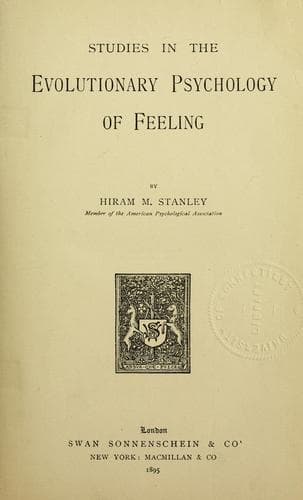
Studies in the Evolutionary Psychology of FeelingStanley, Hiram Miner
Philosophy
Studies in the Evolutionary Psychology of Feeling
Stanley, Hiram Miner
Emotions
But when we come to interpret the psychoses of the lower animals in
connection with sexuality we may still more easily slip into a doubtful
automorphism. Thus to say with Darwin, “When we behold a male bird
elaborately displaying ... before the female, ... it is impossible to
doubt that she admires the beauty of her male partner” (_Descent of
Man_, p. 92), or more strongly still with Grant Allen, “Every crow must
think its own mate _beautiful_” (_Mind_, v. 448), we too easily take for
granted that these birds would feel like ourselves in corresponding
circumstances. We can find a more simple explanation. That crows often
maltreat those who are off colour, _e.g._, white, plainly does not
require us to suppose that they regard white as ugly, black as
beautiful, any more than we should judge that students in some Society
who wear a black badge would be æsthetically moved when they look with
disfavour upon students who may wear a white badge. Animals are
clannish, and as a rule, suffer none but those who have the customary
marks to associate with them, and especially to propagate. Hence when
the peacock displays himself to his mate he simply shows to her that he
has most conspicuously the proper marks, and she sees that he is the
proper mate. These are signs of a tempting mate, just as here is
tempting food, a very red ripe berry, but the coloration no more in the
one case than the other awakens feeling for beauty. The hen bird
probably appreciates a red feather as a red berry merely as being signs
of the completely satisfying. Sexual selection, like nutriment
selection, is a discrimination according to certain characters as
prompted by appetite. The expanded and vari-coloured tail of a peacock
is then a mere sexual characteristic which does not imply feeling for
beauty in its appreciation as significant of sex. A small foot, long
hair, and other sexual characters in woman, which are attractive to men,
in like manner arouse emotion which is far from æsthetic. We may take a
perfectly unsexual æsthetic pleasure in long raven tresses just as we do
in an ebony table, but this is obviously rather late achievement.
In fact are not æsthetic and sexual feelings mutually exclusive? So far
as nude art is “suggestive,” so far is the feeling of its beauty lost,
hence sculpture is not tinted. And so in the presence of the nude model
the artist can have merely æsthetic emotion, whereas his visitor is apt
to have emotions of another sort. We do, indeed, say that the lover
dwells upon his mistress’ “beauties,” but beauties here mean
attractions, and to the devoted lover all parts are attractive, even
moles and freckles which to the æsthetic eye are ugly.
Public-domain text, read in full here on John Shaqi.
Reviews
Reviews
No reviews yet
Be the first to share your thoughts on this work.
Elsewhere in the archive
Join the Discussion
Join the discussion
Sign in to leave a comment or review.
Sign InorCreate an account