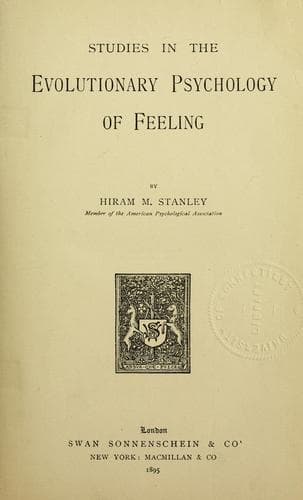
Studies in the Evolutionary Psychology of FeelingStanley, Hiram Miner
Philosophy
Studies in the Evolutionary Psychology of Feeling
Stanley, Hiram Miner
Emotions
Another way of accounting for æsthetic psychosis is by association.
Pleasant sights, for instance, are those with which we associate
pleasure, and “pleasant” means to many, beautiful. But a traveller,
thirsty in a desert land, declares that he saw no more pleasant sight
than a mud hole, but this pleasure, as he himself would aver, was far
from æsthetic. Whatever we have associated pleasure with, we regard with
pleasure, but only as we have associated æsthetic pleasure with it do we
regard it with æsthetic pleasure. Thus mere association or revival no
more gives us the derivation of æsthetic than any other emotion. Any
pleasure or pain may be associated with any sensation or perception, and
thereby re-occur with these, but the mere revival obviously does not
alter the nature of the psychosis or give any new psychosis. It is not
what is recalled, but how we _feel about_ it that constitutes æsthetic
emotion. So also when the beautiful is defined by H. R. Marshall as “the
permanently pleasurable in revival,” we get no insight into the origin,
nature, and development of the æsthetic psychosis; this purely objective
description gives no psychological analysis. But we may question the
accuracy of the description. A thing of beauty is not a joy for ever
when we mean thereby the object which excites the æsthetic psychosis,
for much that has seemed beautiful to one people and age does not remain
so for all peoples and times, and even with the individual, taste
varies. We must also note that the permanently pleasurable in revival
may not be æsthetic, as the lover’s remembrance of a trysting place. On
the whole, I do not find that æsthetic pleasure is in any case to be
ascribed to association, though it comes under the general laws of
association like any other feeling. A lily excites various modes of
æsthetic impression by its form, colour, odour, poetical character,
etc., all which may re-awaken together upon any presentation or
suggestion of the lily. However, for the aboriginal lotus-eater the lily
was also a pleasant sight—but not æsthetic—from the associated pleasures
of its pleasant taste and as satisfying hunger.
Public-domain text, read in full here on John Shaqi.
Reviews
Reviews
No reviews yet
Be the first to share your thoughts on this work.
Elsewhere in the archive
Join the Discussion
Join the discussion
Sign in to leave a comment or review.
Sign InorCreate an account