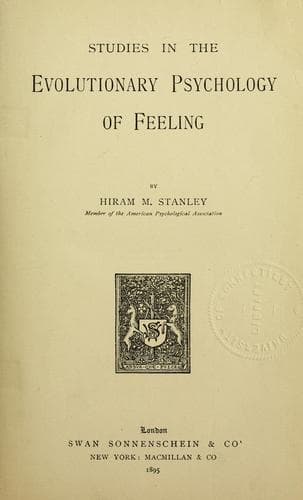
Studies in the Evolutionary Psychology of FeelingStanley, Hiram Miner
Philosophy
Studies in the Evolutionary Psychology of Feeling
Stanley, Hiram Miner
Emotions
We have implied throughout—and common introspection approves this—that
æsthetic pleasure and emotion is a distinct psychosis which somehow
arises with reference to objects. It is not some previous psychosis as
modified by association, habit, economy, play-impulse, or sexuality; but
it is a _sui generis_ mode which develops on the basis of a past
evolution. The simplest and earliest æsthetic mode is plainly the
sensuous. Very commonly when looking on the delicate solid-tinted glow
of early dawn I have æsthetic pleasure, my eye dwells on it with
pleasure and drinks in the pleasant light. It is obvious here that the
sensing activity is carried on, not to discriminate food or mate nor yet
as mere vent to energy; but the sensing here acts for the pleasure in
the activity itself. How and why mere cognitive act, which originates as
guide to life, acquires a direct pleasure value and so is carried on
apart from the ends of life, and initiates an æsthetic world of its own,
cannot on the face of it be explained by natural selection; it is
entirely apart from this order of things. But we know that sensing often
carries pleasure with it as significant of life value, thus the thing
tasting good was originally the good thing to eat, digest and
assimilate; so also for smell, etc. But under natural selection this
pleasure sanction and index was never cultivated for its own sake.
Now is there any real difference in the pleasure in, for instance,
smelling, for the pure pleasure of smelling, as a perfume of fresh
apples, and the pleasure from smelling the apples as detecting them when
you are hungry? “How pleasant those apples smell! I do not care to eat
them, but I just enjoy smelling them”; is the pleasure thus indicated
the same in quality with that of the man who says, “Those apples smell
so nice I would like to try one”? Again, if hungry, we say, “The bread
tastes so _good_,” but we notice this pleasantness rapidly decreases as
appetite is satisfied. However, if there be fresh grass butter, you may
continue to eat long after appetite is satisfied, for the pure pleasure
of the taste. Obviously, the latter pleasure is not a mere continuance
of the former. Relish and taste pleasure seem distinct. Again, a red
apple is a pleasant sight to a hungry man and to an artist in different
ways. If our pleasure in looking at a picture of an apple is such that
the mouth waters, we know at once that the pleasure is unæsthetic. He
who is very fond of apples, and to whom they are always a pleasant
sight, is so far barred from æsthetic pleasure in them; while he who has
no appreciation of their edibility is thereby prepared for æsthetically
sensing them. So also sour grapes are as pretty as sweet. The colour
sense began as discriminative of foods, and hence red became pleasurably
known, but æsthetic appreciation is certainly much later and quite
diverse. If it be asked how and when did red, already noticeable, become
Public-domain text, read in full here on John Shaqi.
Reviews
Reviews
No reviews yet
Be the first to share your thoughts on this work.
Elsewhere in the archive
Join the Discussion
Join the discussion
Sign in to leave a comment or review.
Sign InorCreate an account