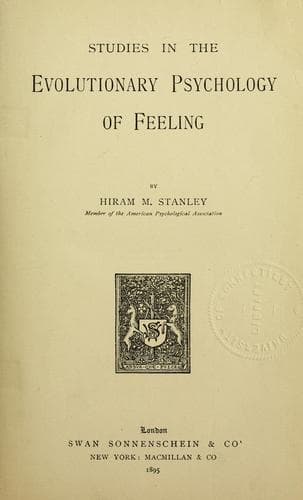
Studies in the Evolutionary Psychology of FeelingStanley, Hiram Miner
Philosophy
Studies in the Evolutionary Psychology of Feeling
Stanley, Hiram Miner
Emotions
pleasure of the taste, and exercises this sense æsthetically. The
æsthetic of all these senses may be called the lower æsthetic, in
contradistinction to the higher æsthetic of sight and hearing; but
æsthetic activity is throughout its whole range practically identical in
nature and in the quality of its pleasure. When I lie in the sun and get
warmth, not because I am cold, but for the mere pleasure of the warmth
thrills, and when I keep looking at a delicate tint in the evening sky
for the mere pleasure of the sensation, I have, as far as my
introspection assures me, activities whose method and pleasure tone is
identical.
Simple sensuous æsthetic is no doubt the beginning of æsthetic activity,
but there speedily enters much complication. It often happens that
single elements which separately do not excite us æsthetically will
produce a marked effect in conjunction, as complementary colours, for
instance. Indeed, relation plays so large a place in our æsthetic
experience that such principles as variety and contrast, or, on the
other hand, unity, order, proportion, and harmony, have been made
fundamental to the æsthetic feeling. Æsthetic effect certainly here
becomes a complex of two or more reinforcing sensations or perceptions.
Where the sensuous elements of a perception are in themselves pleasing
we may expect the unison in perception to be doubly pleasing. However,
we may also conceive that æsthetic pleasure arises as a reflex of
perceptive activity in and for itself as a co-ordinating of impressions.
Fechner has made some experiments on what combinations are pleasing; but
experiment in this direction is extremely difficult because so few
people are willing to speak frankly of their æsthetic feelings, being
very sensitive about compromising themselves on matters of taste. There
is also the great difficulty of isolation, of making sure that
association does not creep in and add unforeseen elements. If Fechner
expected to get any judgments of value on such a matter as the golden
section rectangle, he should have consulted only trained artists who are
used to taking up the æsthetic activity with reference to any material
and expressing themselves with freedom. If this rectangle has the
æsthetic quality Fechner’s experiments suggest, it seems strange it was
not adopted by the symmetry-loving Greeks in their temples, like the
Parthenon.
Public-domain text, read in full here on John Shaqi.
Reviews
Reviews
No reviews yet
Be the first to share your thoughts on this work.
Elsewhere in the archive
Join the Discussion
Join the discussion
Sign in to leave a comment or review.
Sign InorCreate an account